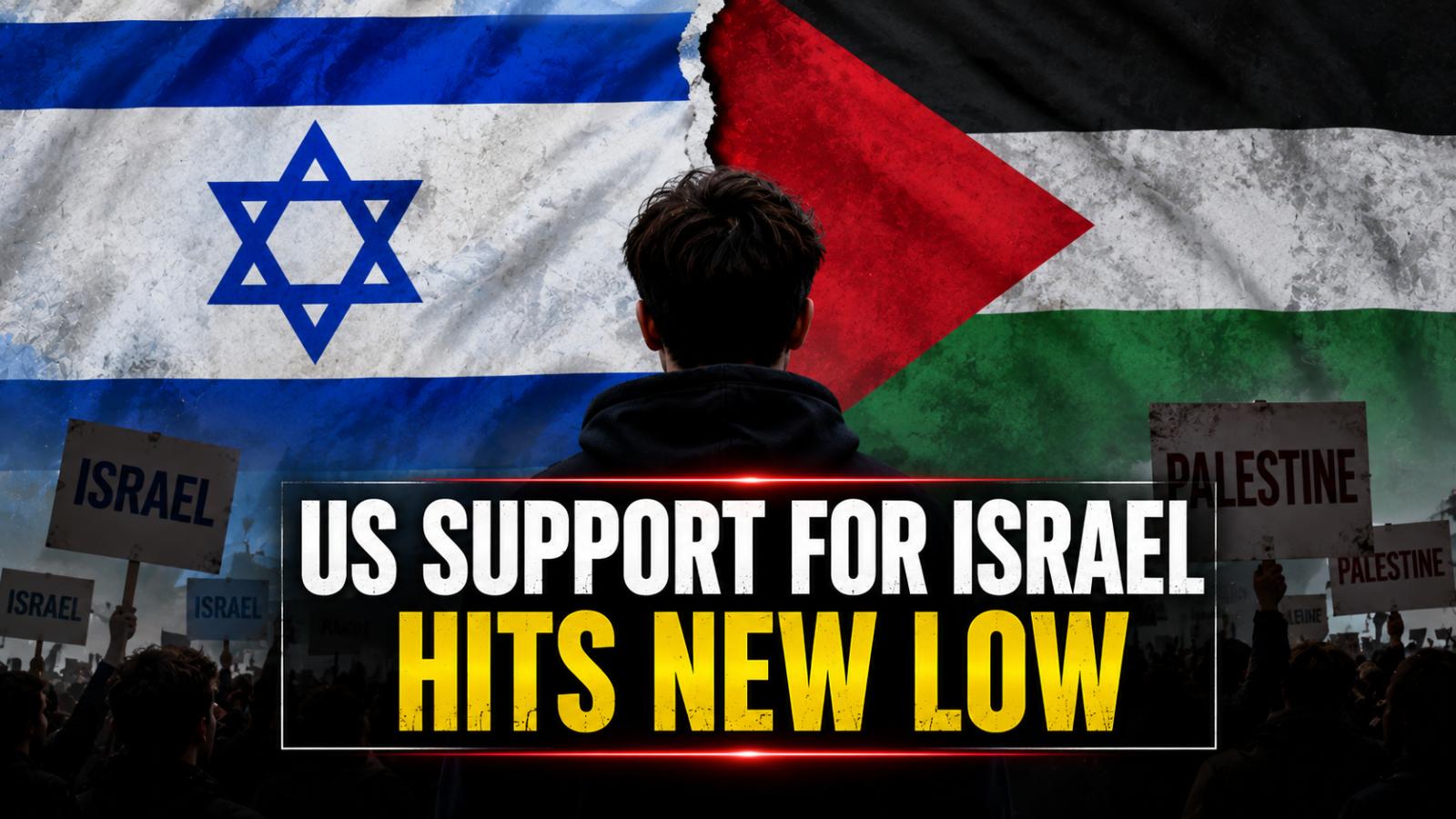
For decades, US support for Israel was among the most durable features of American foreign policy. That political foundation has not disappeared, but public opinion is changing sharply. New polling shows Palestinians overtaking Israelis in American sympathies for the first time in Gallup's long-running trend, while younger voters are driving an even larger shift.
Gallup poll marks historic shift in US Israel support
Gallup's February 2026 survey found that 41% of Americans sympathised more with Palestinians, compared with 36% who sympathised more with Israelis. A year earlier, Israelis still held a 46%-33% advantage. The reversal represents a dramatic change from the overwhelmingly pro-Israel margins recorded during much of the past quarter-century.
The shift does not mean Americans have uniformly turned against Israel. Party affiliation, age and views of the Gaza war remain major dividing lines. Support for a two-state solution also differs sharply by party, with Gallup finding considerably stronger backing among Democrats and independents than Republicans.
Young voters widen the Israel-Palestine divide
Age produces one of the clearest differences. Pew Research Center reported in July that only 32% of Americans under 30 viewed Israeli people favourably, compared with 58% who viewed Palestinian people favourably. Among Democrats under 30, the gap widened to 26% for Israelis and 72% for Palestinians.
Separate Pew research found only 23% of US adults aged 18 to 34 held a favourable view of Israel as a country, while 74% viewed it unfavourably. Among Americans aged 50 and above, favourable and unfavourable views were evenly divided at 49%.
The generational divide reflects different political experiences. Older Americans encountered Israel through the Holocaust's aftermath, the Arab-Israeli wars and decades of close US-Israel cooperation. Younger voters have grown up amid occupation, failed peace efforts and, most recently, graphic images of destruction and civilian suffering from Gaza circulating continuously through social media.
Gaza war reshapes domestic US politics
The October 7, 2023 Hamas-led attack, which killed about 1,200 people in Israel and involved the taking of roughly 250 hostages, initially generated widespread sympathy for Israel. Israel's subsequent military campaign in Gaza, however, has increasingly divided American opinion as civilian casualties and destruction mounted.
The political consequences are becoming visible beyond polling. The International Criminal Court issued an arrest warrant for Israeli Prime Minister Benjamin Netanyahu in November 2024 over alleged war crimes and crimes against humanity.
New York Mayor Zohran Mamdani previously argued that the warrant should be honoured. In July, however, he acknowledged after a legal review that New York City itself lacks authority to execute the ICC warrant.
An Economist/YouGov survey conducted in late July found 49% of Americans supported arresting Netanyahu if he entered the United States, while 27% opposed such action.
El-Sayed victory shows shift inside Democratic Party
The changing politics of Israel also surfaced in Michigan's Democratic Senate primary. Progressive Abdul El-Sayed narrowly defeated Rep. Haley Stevens despite enormous outside spending against him. El-Sayed campaigned in part on cutting US military assistance to Israel, making the result a significant test of how attitudes toward Israel are changing inside the Democratic coalition.
The result should not be treated as proof that American voters nationally have rejected the US-Israel alliance. Michigan's November general election against Republican Mike Rogers will provide a much tougher test of whether the progressive message can succeed with a broader electorate.
US Israel relationship enters a less predictable era
The most defensible conclusion is not that America's relationship with Israel is "over." Military, diplomatic and institutional ties remain deep. What is weakening is the assumption that strong support for Israel automatically commands bipartisan public backing.
Gallup and Pew now document a structural generational divide, while Gaza, Netanyahu and US military assistance have become increasingly contentious issues in domestic politics. Even disagreement on the political right over foreign intervention is making the debate less predictable.
For Israel, the long-term challenge may therefore be demographic as much as diplomatic. Younger Americans hold markedly different views from the generations that built the modern US-Israel relationship. As those voters gain political influence, Washington's approach to Israel and Palestine is likely to face pressures that would have seemed improbable only a decade ago.