










India-US relations: Jaishankar stresses partnership with dignity
India-US relations have become stronger and more important, but External Affairs Minister S. Jaishankar has made it clear that the partnership is not without challenges. His message is simple: India and America may have differences on trade, energy, diplomacy and global issues, but both countries must handle them maturely and keep the relationship moving forward. He sees the relationship as a serious strategic partnership based on shared interests, not as a one-sided friendship or dependence.
India-US relations: Jaishankar stresses partnership with dignity
India-US relations have become stronger and more important, but External Affairs Minister S. Jaishankar has made it clear that the partnership is not without challenges. His message is simple: India and America may have differences on trade, energy, diplomacy and global issues, but both countries must handle them maturely and keep the relationship moving forward. He sees the relationship as a serious strategic partnership based on shared interests, not as a one-sided friendship or dependence.

Indian Student Grocery Packing Guide for Dallas
For Indian students traveling to Dallas for the first time, grocery packing can be confusing. Many students wonder whether they should carry rice, dal, atta, masalas, snacks, ready-to-eat packets or other food items from India. The simple answer is this: carry only a small grocery starter kit for the first one or two weeks. Dallas has a large Indian community and good Indian grocery availability, so students do not need to fill their luggage with food. For most students, grocery packing should be about first-week comfort, not long-term storage. How Much Grocery Should Indian Students Carry to Dallas? For most Indian students, 3 kg to 4 kg of groceries is enough. Even if a student has around 44 kg to 46 kg of check-in luggage, groceries should take only a small part of that space. The remaining luggage is more useful for clothes, winter wear, documents, medicines, laptop items, shoes and student essentials. A practical grocery weight plan looks like this: Spices and masalas: 500g to 700g Ready-to-eat food: 1 kg to 1.5 kg Instant mixes: 500g to 800g Snacks and biscuits: 500g to 800g Tea, coffee or small pickle: 300g to 500g Total ideal grocery weight: 2.5 kg to 3.5 kg Maximum suggested grocery weight: 4 kg Why Carry Groceries From India? Indian students should carry groceries mainly for convenience during the first few days after landing. After reaching Dallas, students may be busy with airport travel, housing setup, university formalities, SIM card, bank account work and transportation. During this time, a few ready-to-eat packets, instant mixes and familiar snacks can be helpful. Some students may also prefer carrying their favorite regional masalas, chutney powder, sambar powder, rasam powder or tea brand because the exact taste may not be immediately available near their apartment. However, students should not treat groceries as the main part of their luggage. Best Grocery Items to Carry From India Students should carry only sealed, branded and commercially packed food items. Good options include: Ready-to-eat vegetarian packets Carry 4 to 6 packets. These are useful during the first few days when cooking may not be possible. Instant breakfast mixes Carry 2 to 3 packets of poha, upma, idli mix, dosa mix or similar items. Small masala packets Carry limited quantities of turmeric powder, chilli powder, garam masala, sambar powder, rasam powder or biryani masala. Regional taste items Students can carry chutney powder, special spice mix or a favorite regional masala if it is properly sealed and labelled. Tea or coffee Carry one small pack if you prefer a specific Indian brand. Snacks Carry 3 to 5 small packets of biscuits, namkeen, khakhra, chikki or dry snacks for travel and the first week. Pickle Carry only one small sealed branded bottle if needed. Pack it carefully in check-in baggage to avoid leakage. What Not to Carry From India: Buy These in Dallas Instead Indian students traveling to Dallas should avoid carrying heavy daily groceries such as rice, dal, atta, oil, ghee, sugar and salt. These items are easily available in Indian grocery stores across the Dallas-Fort Worth area and can be bought after arrival. Carrying these items from India usually does not help much because they take up luggage space, add weight quickly and are not difficult to find in Dallas. A student’s check-in baggage is better used for clothes, winter wear, documents, medicines, personal items and first-week essentials. Students should also avoid carrying fresh fruits, fresh vegetables, curry leaves, coriander leaves, mint leaves, seeds, plants, soil, homemade pickles, homemade chutneys, meat products, egg-based food items and loose masala powders without original labels. These items may create problems during U.S. customs inspection. For regular cooking after arrival, students can buy rice, dal, atta, oil, ghee, vegetables, paneer, frozen chapati, dosa batter, snacks and larger masala packs from local Indian grocery stores in Dallas. The best approach is simple: carry only 3 kg to 4 kg of sealed, dry, branded food items from India and buy heavy regular groceries after reaching Dallas. Should Groceries Go in Check-In or Cabin Baggage? Students should keep almost all groceries in check-in baggage. Check-in baggage is better for: Masala powders Sambar powder Rasam powder Chutney powder Ready-to-eat packets Instant mixes Pickle bottles Tea or coffee Snacks in larger quantities Cabin baggage should carry only small travel snacks such as biscuits, dry fruits, chocolate, protein bars or one small namkeen packet. Avoid keeping pickle, chutney, liquid food, large masala packets or too many powders in cabin baggage. This can create extra security checking during travel. How to Pack Groceries Safely Students should keep grocery packing simple and clean. Use original sealed packets. Do not open and repack masalas into plain covers. Keep all food items together in one transparent plastic bag or pouch inside checked baggage. Double-wrap pickle or liquid-based items. Avoid glass bottles if possible. Keep food away from clothes. Do not carry anything that smells strongly or leaks easily. Keep total grocery weight below 4 kg. U.S. Customs Rule: Declare Food Items Students should declare all food items when entering the United States. If asked at the airport, students can clearly say: “I have sealed Indian dry spices, vegetarian ready-to-eat packets, tea and snacks. I am not carrying fresh fruits, vegetables, meat, seeds or plants.” Declaring food is safer than hiding it. If an officer decides that an item is not allowed, it may be removed, but proper declaration helps avoid bigger problems. What to Buy After Reaching Dallas After arrival, students can buy regular cooking items locally. See our guide to Indian grocery stores in Dallas-Fort Worth for nearby stores, timings and shopping options. After reaching Dallas, students can buy regular Indian groceries locally instead of carrying heavy items from India. Indian grocery stores in the Dallas-Fort Worth area usually sell daily cooking items, Indian snacks, masalas, frozen foods, fresh vegetables and other student-friendly groceries. After arrival, students can use local Indian grocery stores for regular purchases. For store options, read our guide to Indian grocery stores in Dallas-Fort Worth. Final Grocery Packing Checklist Carry from India: 4 to 6 ready-to-eat vegetarian packets 2 to 3 instant breakfast mixes Small masala packets Sambar powder or rasam powder Chutney powder or regional spice mix Tea or coffee A few snacks One small sealed pickle bottle, optional Keep grocery weight around 3 kg to 4 kg maximum. Final Advice for Indian Students Students planning their complete luggage can also read our full India to Dallas student packing checklist for documents, clothes, toiletries, medicines, cabin bag items and first-week essentials For Indian students traveling to Dallas, groceries should be a small comfort kit, not a major part of luggage. The smartest plan is to carry a few sealed food items for the first week and buy regular groceries after reaching Dallas. This keeps luggage lighter, reduces customs risk and gives students more space for important items. Students planning their complete luggage can also read our full India to Dallas student packing checklist.
Indian Student Grocery Packing Guide for Dallas
For Indian students traveling to Dallas for the first time, grocery packing can be confusing. Many students wonder whether they should carry rice, dal, atta, masalas, snacks, ready-to-eat packets or other food items from India. The simple answer is this: carry only a small grocery starter kit for the first one or two weeks. Dallas has a large Indian community and good Indian grocery availability, so students do not need to fill their luggage with food. For most students, grocery packing should be about first-week comfort, not long-term storage. How Much Grocery Should Indian Students Carry to Dallas? For most Indian students, 3 kg to 4 kg of groceries is enough. Even if a student has around 44 kg to 46 kg of check-in luggage, groceries should take only a small part of that space. The remaining luggage is more useful for clothes, winter wear, documents, medicines, laptop items, shoes and student essentials. A practical grocery weight plan looks like this: Spices and masalas: 500g to 700g Ready-to-eat food: 1 kg to 1.5 kg Instant mixes: 500g to 800g Snacks and biscuits: 500g to 800g Tea, coffee or small pickle: 300g to 500g Total ideal grocery weight: 2.5 kg to 3.5 kg Maximum suggested grocery weight: 4 kg Why Carry Groceries From India? Indian students should carry groceries mainly for convenience during the first few days after landing. After reaching Dallas, students may be busy with airport travel, housing setup, university formalities, SIM card, bank account work and transportation. During this time, a few ready-to-eat packets, instant mixes and familiar snacks can be helpful. Some students may also prefer carrying their favorite regional masalas, chutney powder, sambar powder, rasam powder or tea brand because the exact taste may not be immediately available near their apartment. However, students should not treat groceries as the main part of their luggage. Best Grocery Items to Carry From India Students should carry only sealed, branded and commercially packed food items. Good options include: Ready-to-eat vegetarian packets Carry 4 to 6 packets. These are useful during the first few days when cooking may not be possible. Instant breakfast mixes Carry 2 to 3 packets of poha, upma, idli mix, dosa mix or similar items. Small masala packets Carry limited quantities of turmeric powder, chilli powder, garam masala, sambar powder, rasam powder or biryani masala. Regional taste items Students can carry chutney powder, special spice mix or a favorite regional masala if it is properly sealed and labelled. Tea or coffee Carry one small pack if you prefer a specific Indian brand. Snacks Carry 3 to 5 small packets of biscuits, namkeen, khakhra, chikki or dry snacks for travel and the first week. Pickle Carry only one small sealed branded bottle if needed. Pack it carefully in check-in baggage to avoid leakage. What Not to Carry From India: Buy These in Dallas Instead Indian students traveling to Dallas should avoid carrying heavy daily groceries such as rice, dal, atta, oil, ghee, sugar and salt. These items are easily available in Indian grocery stores across the Dallas-Fort Worth area and can be bought after arrival. Carrying these items from India usually does not help much because they take up luggage space, add weight quickly and are not difficult to find in Dallas. A student’s check-in baggage is better used for clothes, winter wear, documents, medicines, personal items and first-week essentials. Students should also avoid carrying fresh fruits, fresh vegetables, curry leaves, coriander leaves, mint leaves, seeds, plants, soil, homemade pickles, homemade chutneys, meat products, egg-based food items and loose masala powders without original labels. These items may create problems during U.S. customs inspection. For regular cooking after arrival, students can buy rice, dal, atta, oil, ghee, vegetables, paneer, frozen chapati, dosa batter, snacks and larger masala packs from local Indian grocery stores in Dallas. The best approach is simple: carry only 3 kg to 4 kg of sealed, dry, branded food items from India and buy heavy regular groceries after reaching Dallas. Should Groceries Go in Check-In or Cabin Baggage? Students should keep almost all groceries in check-in baggage. Check-in baggage is better for: Masala powders Sambar powder Rasam powder Chutney powder Ready-to-eat packets Instant mixes Pickle bottles Tea or coffee Snacks in larger quantities Cabin baggage should carry only small travel snacks such as biscuits, dry fruits, chocolate, protein bars or one small namkeen packet. Avoid keeping pickle, chutney, liquid food, large masala packets or too many powders in cabin baggage. This can create extra security checking during travel. How to Pack Groceries Safely Students should keep grocery packing simple and clean. Use original sealed packets. Do not open and repack masalas into plain covers. Keep all food items together in one transparent plastic bag or pouch inside checked baggage. Double-wrap pickle or liquid-based items. Avoid glass bottles if possible. Keep food away from clothes. Do not carry anything that smells strongly or leaks easily. Keep total grocery weight below 4 kg. U.S. Customs Rule: Declare Food Items Students should declare all food items when entering the United States. If asked at the airport, students can clearly say: “I have sealed Indian dry spices, vegetarian ready-to-eat packets, tea and snacks. I am not carrying fresh fruits, vegetables, meat, seeds or plants.” Declaring food is safer than hiding it. If an officer decides that an item is not allowed, it may be removed, but proper declaration helps avoid bigger problems. What to Buy After Reaching Dallas After arrival, students can buy regular cooking items locally. See our guide to Indian grocery stores in Dallas-Fort Worth for nearby stores, timings and shopping options. After reaching Dallas, students can buy regular Indian groceries locally instead of carrying heavy items from India. Indian grocery stores in the Dallas-Fort Worth area usually sell daily cooking items, Indian snacks, masalas, frozen foods, fresh vegetables and other student-friendly groceries. After arrival, students can use local Indian grocery stores for regular purchases. For store options, read our guide to Indian grocery stores in Dallas-Fort Worth. Final Grocery Packing Checklist Carry from India: 4 to 6 ready-to-eat vegetarian packets 2 to 3 instant breakfast mixes Small masala packets Sambar powder or rasam powder Chutney powder or regional spice mix Tea or coffee A few snacks One small sealed pickle bottle, optional Keep grocery weight around 3 kg to 4 kg maximum. Final Advice for Indian Students Students planning their complete luggage can also read our full India to Dallas student packing checklist for documents, clothes, toiletries, medicines, cabin bag items and first-week essentials For Indian students traveling to Dallas, groceries should be a small comfort kit, not a major part of luggage. The smartest plan is to carry a few sealed food items for the first week and buy regular groceries after reaching Dallas. This keeps luggage lighter, reduces customs risk and gives students more space for important items. Students planning their complete luggage can also read our full India to Dallas student packing checklist.

Can NRIs Apply for Padma Awards 2027? Rules Explained
NRIs, OCI holders, PIOs and foreign citizens can be nominated for the Padma Awards 2027, including Padma Bhushan, if their work shows distinguished service, public impact or exceptional achievement. India’s Ministry of Home Affairs said nominations for the Padma Awards 2027 opened on Sunday, March 15, 2026, and will close on Friday, July 31, 2026. The awards are expected to be
Can NRIs Apply for Padma Awards 2027? Rules Explained
NRIs, OCI holders, PIOs and foreign citizens can be nominated for the Padma Awards 2027, including Padma Bhushan, if their work shows distinguished service, public impact or exceptional achievement. India’s Ministry of Home Affairs said nominations for the Padma Awards 2027 opened on Sunday, March 15, 2026, and will close on Friday, July 31, 2026. The awards are expected to be

What Is an OCI Card? Benefits, Eligibility and India Travel Rules Explained
An OCI card, or Overseas Citizen of India card, gives eligible foreign citizens of Indian origin long-term access to India. For Indian-origin Americans, the OCI card is especially useful after U.S. citizenship. It helps eligible former Indian citizens and people of Indian origin visit India frequently, stay for longer periods and maintain family, cultural, property and business ties with India. However, OCI is not Indian citizenship. OCI cardholders cannot vote in India, ho
What Is an OCI Card? Benefits, Eligibility and India Travel Rules Explained
An OCI card, or Overseas Citizen of India card, gives eligible foreign citizens of Indian origin long-term access to India. For Indian-origin Americans, the OCI card is especially useful after U.S. citizenship. It helps eligible former Indian citizens and people of Indian origin visit India frequently, stay for longer periods and maintain family, cultural, property and business ties with India. However, OCI is not Indian citizenship. OCI cardholders cannot vote in India, ho

What Is an NRI? Meaning, Benefits, Banking and Property Rules Explained
An NRI, or Non-Resident Indian, is an Indian citizen who lives outside India for work, education, business, family or long-term residence. For Indian citizens living in the United States, NRI status is important because it affects India travel, bank accounts, property ownership, tax treatment, voting rights and long-term financial planning. In simple terms, an NRI remains an Indian citizen while living abroad. This is why NRI status is closely linked to Indian passport righ
What Is an NRI? Meaning, Benefits, Banking and Property Rules Explained
An NRI, or Non-Resident Indian, is an Indian citizen who lives outside India for work, education, business, family or long-term residence. For Indian citizens living in the United States, NRI status is important because it affects India travel, bank accounts, property ownership, tax treatment, voting rights and long-term financial planning. In simple terms, an NRI remains an Indian citizen while living abroad. This is why NRI status is closely linked to Indian passport righ
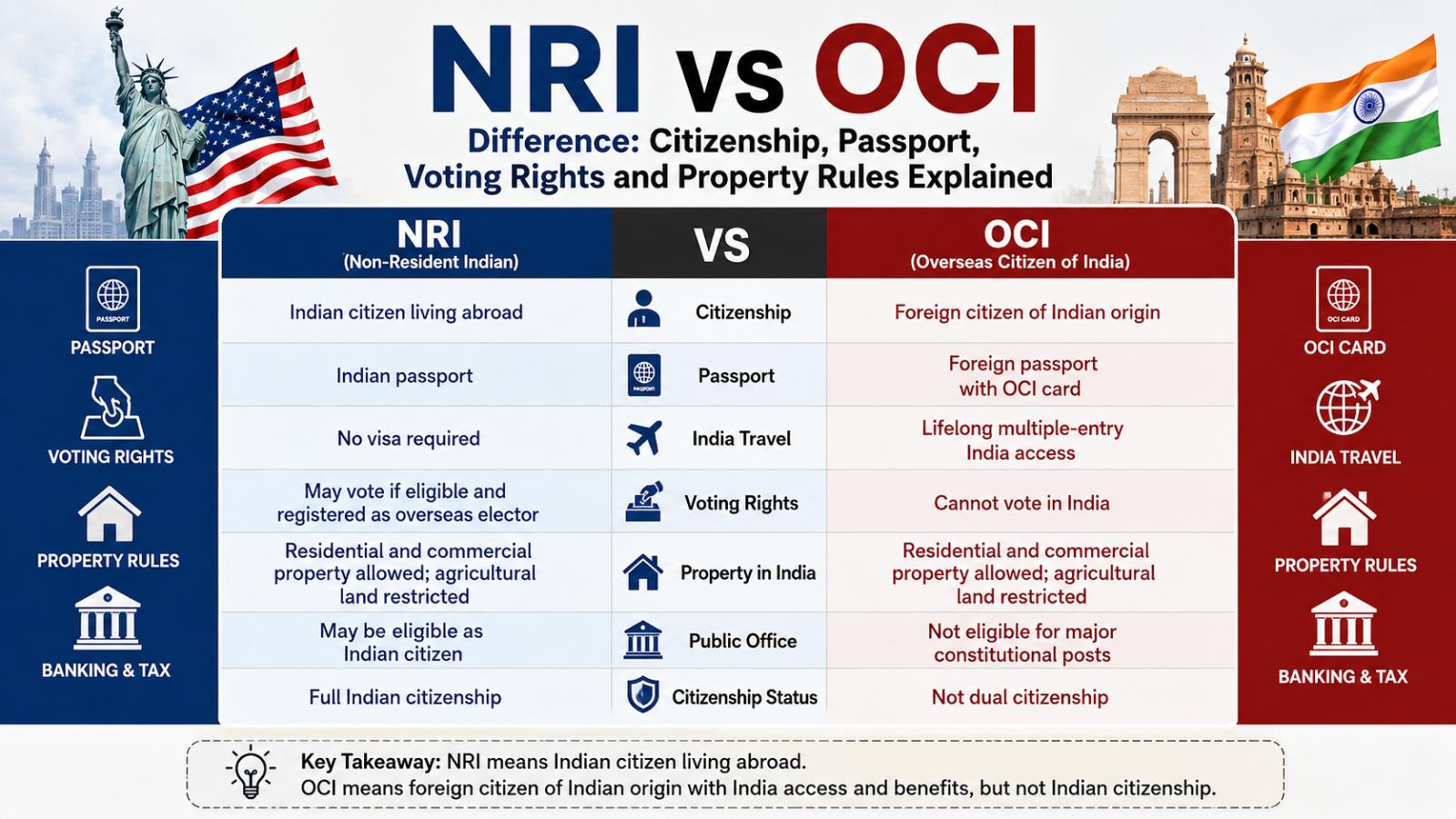
NRI vs OCI Difference: Citizenship, Passport, Voting and Property Rules
NRI vs OCI Difference: What Indian-Origin Americans Should Know The main difference between NRI and OCI is citizenship. An NRI is an Indian citizen living outside India, while an OCI cardholder is a foreign citizen of Indian origin who gets special India-related benefits but not Indian citizenship. For Indian-origin Americans, this difference matters because it affects passport use, India travel, voting rights, property ownership, banking access and long
NRI vs OCI Difference: Citizenship, Passport, Voting and Property Rules
NRI vs OCI Difference: What Indian-Origin Americans Should Know The main difference between NRI and OCI is citizenship. An NRI is an Indian citizen living outside India, while an OCI cardholder is a foreign citizen of Indian origin who gets special India-related benefits but not Indian citizenship. For Indian-origin Americans, this difference matters because it affects passport use, India travel, voting rights, property ownership, banking access and long

33-Year-Old Makes $192K/Month Negotiating Car Deals Remotely
A remote car negotiation service is helping buyers save over $6,000 per deal—and one 33-year-old is earning $192K per month doing it. His business answers a growing question: Can you hire someone to negotiate your car price? The answer is yes—and demand is booming. How the Remote Car Negotiation Service Works Launched in 2023, the entrepreneur began by negotiating deals for free to understand buyer pain points. Aft
33-Year-Old Makes $192K/Month Negotiating Car Deals Remotely
A remote car negotiation service is helping buyers save over $6,000 per deal—and one 33-year-old is earning $192K per month doing it. His business answers a growing question: Can you hire someone to negotiate your car price? The answer is yes—and demand is booming. How the Remote Car Negotiation Service Works Launched in 2023, the entrepreneur began by negotiating deals for free to understand buyer pain points. Aft

Cape Breton University Signs 3 India MoUs to Boost Student Pathways
Cape Breton University Expands India Push With 3 New MoUs Cape Breton University has signed three MoUs in India to expand student exchange, faculty mobility, research collaboration and Canada-linked education pathways for Indian learners. The Nova Scotia-based university’s India outreach was led by President and Vice-Chancellor David C. Dingwall, who visited New Delhi, Gurugram, Noida, Vadodara and Ahmedabad between April 27 and May 2. What Th
Cape Breton University Signs 3 India MoUs to Boost Student Pathways
Cape Breton University Expands India Push With 3 New MoUs Cape Breton University has signed three MoUs in India to expand student exchange, faculty mobility, research collaboration and Canada-linked education pathways for Indian learners. The Nova Scotia-based university’s India outreach was led by President and Vice-Chancellor David C. Dingwall, who visited New Delhi, Gurugram, Noida, Vadodara and Ahmedabad between April 27 and May 2. What Th

Indian student’s death in Chicago highlights mental health and visa stress
A 26-year-old Indian student from Andhra Pradesh died by suicide in Chicago after struggling to find a job post-graduation. Facing financial pressure and emotional stress, he left messages before his death. A fundraiser is underway to support repatriation and assist his family. Indian student’s death in Chicago highlights mental health and visa stress as Iraganaboyina Chandu, a 26-year-old graduate from Andhra Pradesh, died by suicide at his residence in Chicago
Indian student’s death in Chicago highlights mental health and visa stress
A 26-year-old Indian student from Andhra Pradesh died by suicide in Chicago after struggling to find a job post-graduation. Facing financial pressure and emotional stress, he left messages before his death. A fundraiser is underway to support repatriation and assist his family. Indian student’s death in Chicago highlights mental health and visa stress as Iraganaboyina Chandu, a 26-year-old graduate from Andhra Pradesh, died by suicide at his residence in Chicago

UK visa hurdles disrupt career of Indian professional, highlights broader issue
A young Indian professional’s experience reflects a broader reality faced by many Indians working abroad, especially in countries like the UK. After spending several years building a career overseas, many Indian workers hope to transition into long-term roles. However, visa restrictions often become a major hurdle. As work visas near expiration, professionals must secure jobs that offer sponsorship—something that is not always easy to find. Many companies are hesitant to sponsor for
UK visa hurdles disrupt career of Indian professional, highlights broader issue
A young Indian professional’s experience reflects a broader reality faced by many Indians working abroad, especially in countries like the UK. After spending several years building a career overseas, many Indian workers hope to transition into long-term roles. However, visa restrictions often become a major hurdle. As work visas near expiration, professionals must secure jobs that offer sponsorship—something that is not always easy to find. Many companies are hesitant to sponsor for

Indian student found dead in Pittsburgh after going missing, investigation underway
Incidents involving Indian students going missing in the United States have raised growing concern in recent months, with several tragic cases reported across different states. In the latest development, a 17-year-old Indian-origin student, Gautam Raja Rajanikanth, was found dead in Pennsylvania after being reported missing over the weekend, prompting an ongoing investigation by local authorities. Gautam, who was pursuing his 11th grade education in Pittsburgh’s South Fayette area, was last seen on Saturday. According to preliminary information, he became unreachable shortly thereafter, leading his family to file a missing person complaint with the South Fayette Police Department. Authorities initiated a search operation soon after receiving the report, focusing on locating the teenager and determining his whereabouts. Following an extensive search effort, officials confirmed that Gautam’s body was recovered on Monday. While the discovery has brought some closure to the search, the exact circumstances surrounding his death remain unclear. Police have not yet disclosed the cause of death and stated that the investigation is ongoing, with further details expected pending official findings. The sudden loss has deeply affected Gautam’s family, friends, and the wider Indian diaspora community. The case has once again highlighted concerns regarding the safety and well-being of international students in the United States, especially amid a series of similar incidents reported in recent times. Authorities have urged the public to refrain from speculation as the investigation continues. More information is expected to be released as officials complete their inquiries into the tragic incident.
Indian student found dead in Pittsburgh after going missing, investigation underway
Incidents involving Indian students going missing in the United States have raised growing concern in recent months, with several tragic cases reported across different states. In the latest development, a 17-year-old Indian-origin student, Gautam Raja Rajanikanth, was found dead in Pennsylvania after being reported missing over the weekend, prompting an ongoing investigation by local authorities. Gautam, who was pursuing his 11th grade education in Pittsburgh’s South Fayette area, was last seen on Saturday. According to preliminary information, he became unreachable shortly thereafter, leading his family to file a missing person complaint with the South Fayette Police Department. Authorities initiated a search operation soon after receiving the report, focusing on locating the teenager and determining his whereabouts. Following an extensive search effort, officials confirmed that Gautam’s body was recovered on Monday. While the discovery has brought some closure to the search, the exact circumstances surrounding his death remain unclear. Police have not yet disclosed the cause of death and stated that the investigation is ongoing, with further details expected pending official findings. The sudden loss has deeply affected Gautam’s family, friends, and the wider Indian diaspora community. The case has once again highlighted concerns regarding the safety and well-being of international students in the United States, especially amid a series of similar incidents reported in recent times. Authorities have urged the public to refrain from speculation as the investigation continues. More information is expected to be released as officials complete their inquiries into the tragic incident.

Indian-origin tech professional killed in targeted Toronto parking lot shooting
A 37-year-old Indian-origin information technology professional was killed after unidentified assailants opened fire on the vehicle he was travelling in at a shopping centre parking lot in Toronto, according to Canadian police officials. The victim, identified as Chandan Kumar, hailed from Bengaluru Rural district in Karnataka and had been living in Canada for the past six years while working with a private technology company. The incident occurred on Saturday, February 7, when poli
Indian-origin tech professional killed in targeted Toronto parking lot shooting
A 37-year-old Indian-origin information technology professional was killed after unidentified assailants opened fire on the vehicle he was travelling in at a shopping centre parking lot in Toronto, according to Canadian police officials. The victim, identified as Chandan Kumar, hailed from Bengaluru Rural district in Karnataka and had been living in Canada for the past six years while working with a private technology company. The incident occurred on Saturday, February 7, when poli

Report charts Indian migration waves shaping UK economy and tech sector
A new white paper has underscored the deep and lasting contribution of the Indian diaspora to modern Britain, describing the community as the country’s most economically successful migrant group and a central force in national growth. The report, launched at the House of Lords on 5 February, traces decades of migration and documents how successive generations of Indian migrants have supported Britain’s recovery, innovation and competitiveness across multiple sectors of the economy.
Report charts Indian migration waves shaping UK economy and tech sector
A new white paper has underscored the deep and lasting contribution of the Indian diaspora to modern Britain, describing the community as the country’s most economically successful migrant group and a central force in national growth. The report, launched at the House of Lords on 5 February, traces decades of migration and documents how successive generations of Indian migrants have supported Britain’s recovery, innovation and competitiveness across multiple sectors of the economy.

Green card holders barred from SBA small business loans under new US rules
Green card holders will no longer be eligible for government-backed small business loans in the United States beginning March 1, 2026, following a policy change by the US Small Business Administration that tightens citizenship and residency requirements for borrowers. The revised rules limit access to key SBA lending programs exclusively to US citizens and nationals who maintain their principal residence within the country or its territories, effectively barring lawful permanent residents from participation. According to an official policy notice issued in early February, the agency updated its Standard Operating Procedure 50 10 8, the framework that governs lender and development company loan programs. The revision rescinds earlier procedural guidance that permitted limited ownership by foreign nationals or certain residents living outside the United States. Under the new language, every direct and indirect owner of a small business applicant must meet the citizenship criteria. The SBA said the updated rules require 100 percent of ownership interests in any applicant or borrowing entity to be held by eligible US citizens or nationals. As a result, even minority ownership by a legal permanent resident will disqualify a company from receiving SBA-backed financing. The policy applies broadly to applicants, operating companies, and entities tied to the loan structure, leaving little flexibility for mixed-ownership businesses. The change is expected to affect a wide range of small and early-stage firms that rely on SBA loans for working capital, equipment purchases, and expansion. Many startups and family-owned enterprises depend on these lending programs because they offer lower interest rates and government guarantees that make financing more accessible. With the new restrictions in place, businesses that include green card holders among their owners may need to reconsider ownership arrangements or seek alternative sources of credit from private lenders. Agency officials indicated that the revisions align loan eligibility standards with existing federal regulations and a recent executive directive emphasizing stricter residency compliance. The policy will take effect for all new applications submitted on or after the effective date. Existing and prospective borrowers are being advised to review their ownership structures carefully to ensure continued eligibility under the updated requirements. The move marks a significant shift in how federal small business lending programs define qualification, narrowing access to public funds and reshaping the financing landscape for immigrant entrepreneurs. As the implementation date approaches, legal and financial advisers expect increased demand for guidance from affected business owners who must evaluate their options within the new framework.
Green card holders barred from SBA small business loans under new US rules
Green card holders will no longer be eligible for government-backed small business loans in the United States beginning March 1, 2026, following a policy change by the US Small Business Administration that tightens citizenship and residency requirements for borrowers. The revised rules limit access to key SBA lending programs exclusively to US citizens and nationals who maintain their principal residence within the country or its territories, effectively barring lawful permanent residents from participation. According to an official policy notice issued in early February, the agency updated its Standard Operating Procedure 50 10 8, the framework that governs lender and development company loan programs. The revision rescinds earlier procedural guidance that permitted limited ownership by foreign nationals or certain residents living outside the United States. Under the new language, every direct and indirect owner of a small business applicant must meet the citizenship criteria. The SBA said the updated rules require 100 percent of ownership interests in any applicant or borrowing entity to be held by eligible US citizens or nationals. As a result, even minority ownership by a legal permanent resident will disqualify a company from receiving SBA-backed financing. The policy applies broadly to applicants, operating companies, and entities tied to the loan structure, leaving little flexibility for mixed-ownership businesses. The change is expected to affect a wide range of small and early-stage firms that rely on SBA loans for working capital, equipment purchases, and expansion. Many startups and family-owned enterprises depend on these lending programs because they offer lower interest rates and government guarantees that make financing more accessible. With the new restrictions in place, businesses that include green card holders among their owners may need to reconsider ownership arrangements or seek alternative sources of credit from private lenders. Agency officials indicated that the revisions align loan eligibility standards with existing federal regulations and a recent executive directive emphasizing stricter residency compliance. The policy will take effect for all new applications submitted on or after the effective date. Existing and prospective borrowers are being advised to review their ownership structures carefully to ensure continued eligibility under the updated requirements. The move marks a significant shift in how federal small business lending programs define qualification, narrowing access to public funds and reshaping the financing landscape for immigrant entrepreneurs. As the implementation date approaches, legal and financial advisers expect increased demand for guidance from affected business owners who must evaluate their options within the new framework.

Friends honor cricket player Arun Sandram killed in late-night I-40 crash
Family members, friends, and the wider sports community are mourning the sudden and tragic loss of 35-year-old Arun K. Sandram, who was killed in a late-night crash on Interstate 40 in Raleigh. The incident occurred on Sunday evening along the eastbound lanes of I-40, just before the interchange with I-440, leaving loved ones struggling to come to terms with the unexpected loss of a man they describe as kind, energetic, and deeply passionate about sports. The news of his death has sent shockwave
Friends honor cricket player Arun Sandram killed in late-night I-40 crash
Family members, friends, and the wider sports community are mourning the sudden and tragic loss of 35-year-old Arun K. Sandram, who was killed in a late-night crash on Interstate 40 in Raleigh. The incident occurred on Sunday evening along the eastbound lanes of I-40, just before the interchange with I-440, leaving loved ones struggling to come to terms with the unexpected loss of a man they describe as kind, energetic, and deeply passionate about sports. The news of his death has sent shockwave

Pravasi Sampark NRI meet highlights Bank of India’s global banking focus
Bank of India’s Mumbai North Zone recently organised an NRI Meet titled “Pravasi Sampark” as part of its ongoing efforts to deepen engagement with Non-Resident Indian customers and better understand their evolving banking, investment, and remittance requirements. The initiative reflects the bank’s focus on strengthening long-term relationships with the global Indian diaspora by offering customer-centric and technology-driven financial solutions. The event was attended by sen
Pravasi Sampark NRI meet highlights Bank of India’s global banking focus
Bank of India’s Mumbai North Zone recently organised an NRI Meet titled “Pravasi Sampark” as part of its ongoing efforts to deepen engagement with Non-Resident Indian customers and better understand their evolving banking, investment, and remittance requirements. The initiative reflects the bank’s focus on strengthening long-term relationships with the global Indian diaspora by offering customer-centric and technology-driven financial solutions. The event was attended by sen

Sergey Brin reflects on Google Glass failure and lessons for student innovators
Success stories in technology are often presented as clean narratives of vision, speed and inevitable triumph. An idea is born, a product is launched, and adoption follows. For students and young entrepreneurs trying to understand how innovation truly unfolds, these stories can feel motivating yet incomplete. The more useful insights frequently emerge not from success, but from missteps that expose the limits of confidence, timing and execution. That perspective was at the center of
Sergey Brin reflects on Google Glass failure and lessons for student innovators
Success stories in technology are often presented as clean narratives of vision, speed and inevitable triumph. An idea is born, a product is launched, and adoption follows. For students and young entrepreneurs trying to understand how innovation truly unfolds, these stories can feel motivating yet incomplete. The more useful insights frequently emerge not from success, but from missteps that expose the limits of confidence, timing and execution. That perspective was at the center of
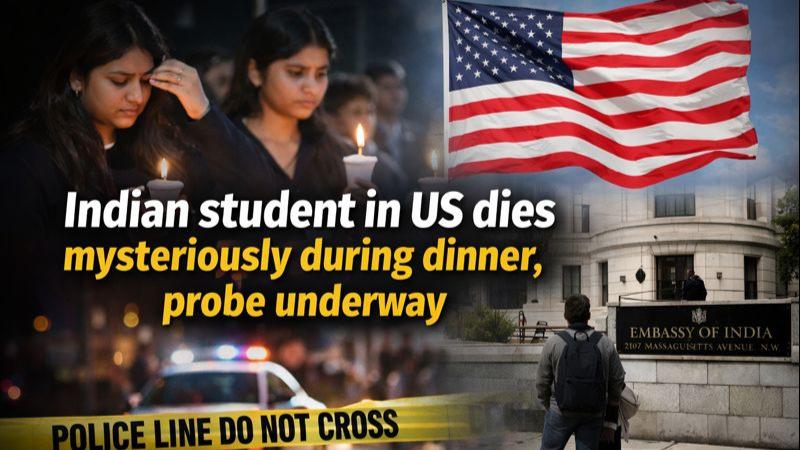
Indian student in US dies mysteriously during dinner, probe underway
An Indian student from Telangana pursuing higher education in the United States has died under suspicious circumstances, triggering concern among the Indian diaspora and student communities. The deceased has been identified as Pawan Kumar Reddy, a native of Melladuppalapalli village in Nalgonda district. The incident reportedly occurred late at night while he was having dinner with his friends.
Indian student in US dies mysteriously during dinner, probe underway
An Indian student from Telangana pursuing higher education in the United States has died under suspicious circumstances, triggering concern among the Indian diaspora and student communities. The deceased has been identified as Pawan Kumar Reddy, a native of Melladuppalapalli village in Nalgonda district. The incident reportedly occurred late at night while he was having dinner with his friends.

How to Transition from Corporate to Consulting in Your 40s
Switching from a long corporate career to consulting in your 40s can feel both exciting and overwhelming. You may wonder whether clients will trust you, whether your skills are relevant in today’s market, or whether it is too late to start something new. The truth is—your 40s are one of the best times to begin consulting. You have industry experience, leadership exposure, professional networks, and the maturity to offer real strategic value. With the right plan, you can
How to Transition from Corporate to Consulting in Your 40s
Switching from a long corporate career to consulting in your 40s can feel both exciting and overwhelming. You may wonder whether clients will trust you, whether your skills are relevant in today’s market, or whether it is too late to start something new. The truth is—your 40s are one of the best times to begin consulting. You have industry experience, leadership exposure, professional networks, and the maturity to offer real strategic value. With the right plan, you can

Andhra Pradesh student found dead in US after falling ill for days
A 23-year-old student from Andhra Pradesh, identified as Rajyalakshmi (Raji) Yarlagadda, was found dead in her apartment in the United States earlier this week. The young woman, who had recently completed her master’s degree in computer science at Texas A&M University–Corpus Christi, had been actively searching for job opportunities following her graduation. Her death has sent shockwaves through her family and friends, both in India and abroad. According to details shared by
Andhra Pradesh student found dead in US after falling ill for days
A 23-year-old student from Andhra Pradesh, identified as Rajyalakshmi (Raji) Yarlagadda, was found dead in her apartment in the United States earlier this week. The young woman, who had recently completed her master’s degree in computer science at Texas A&M University–Corpus Christi, had been actively searching for job opportunities following her graduation. Her death has sent shockwaves through her family and friends, both in India and abroad. According to details shared by