































Jannik Sinner survives five-set Wimbledon scare against Kecmanovic
LONDON — Jannik Sinner survived a five-set Wimbledon scare on Monday, June 29, 2026, defeating Miomir Kecmanovic 4-6, 6-3, 6-7 (6), 6-2, 6-3 in the first round on Centre Court. The defending champion twice recovered from a one-set deficit and overcame a fall during the 3-hour, 30-minute match. The victory sent the world No. 1 into the second round and kept his Wimbledon title defense alive. How Jannik Sinner survived his Wimbledon opener Kecm
Jannik Sinner survives five-set Wimbledon scare against Kecmanovic
LONDON — Jannik Sinner survived a five-set Wimbledon scare on Monday, June 29, 2026, defeating Miomir Kecmanovic 4-6, 6-3, 6-7 (6), 6-2, 6-3 in the first round on Centre Court. The defending champion twice recovered from a one-set deficit and overcame a fall during the 3-hour, 30-minute match. The victory sent the world No. 1 into the second round and kept his Wimbledon title defense alive. How Jannik Sinner survived his Wimbledon opener Kecm
Rolls-Royce Eyes India Manufacturing Investment Under UK Pact
Rolls-Royce and India discussed deeper manufacturing investment, technology partnerships and an engine proposal tied to the country’s next-generation AMCA fighter program on Friday, June 26, 2026. The talks focused on how the India-UK Comprehensive Economic and Trade Agreement, or CETA, could support advanced manufacturing, engineering cooperation and more resilient supply chains. Rolls-Royce India Manufacturing Investment
Rolls-Royce Eyes India Manufacturing Investment Under UK Pact
Rolls-Royce and India discussed deeper manufacturing investment, technology partnerships and an engine proposal tied to the country’s next-generation AMCA fighter program on Friday, June 26, 2026. The talks focused on how the India-UK Comprehensive Economic and Trade Agreement, or CETA, could support advanced manufacturing, engineering cooperation and more resilient supply chains. Rolls-Royce India Manufacturing Investment
Russian army dissent claims raise tension over Ukraine war
A video circulating online featuring former Russian volunteer commander Alexander Lunin has triggered discussion about possible internal strain within sections of Russia’s military. In the recording, he suggests that prolonged combat operations in Ukraine have created growing frustration among some soldiers, though no independent verification supports claims of organized unrest. The remarks have drawn attention because public criticism linke
Russian army dissent claims raise tension over Ukraine war
A video circulating online featuring former Russian volunteer commander Alexander Lunin has triggered discussion about possible internal strain within sections of Russia’s military. In the recording, he suggests that prolonged combat operations in Ukraine have created growing frustration among some soldiers, though no independent verification supports claims of organized unrest. The remarks have drawn attention because public criticism linke
B-52 drag chute system and landing braking explained
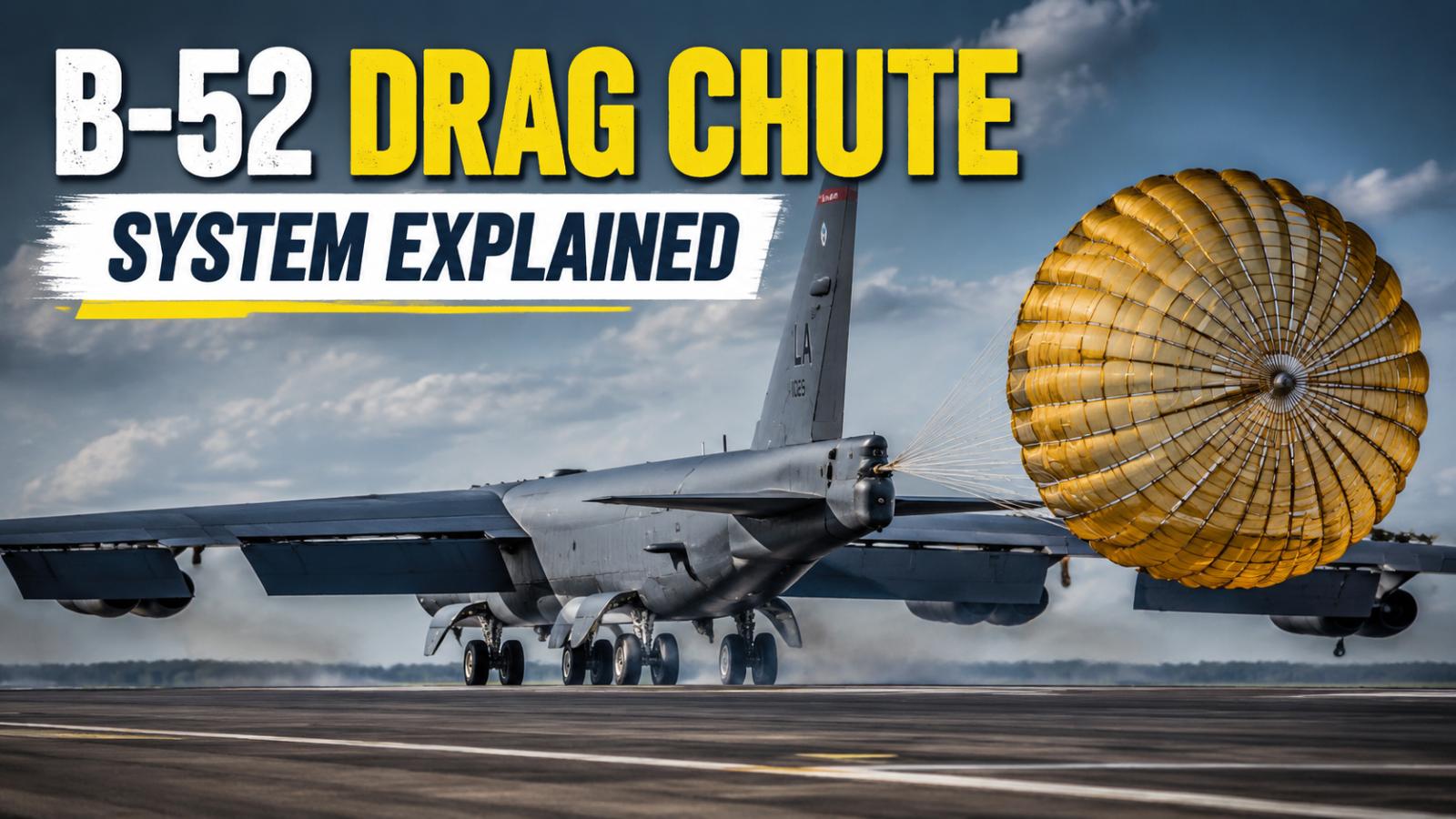
The B-52 Stratofortress relies on a drag chute to help slow the aircraft immediately after touchdown. Instead of depending only on wheel brakes, the system deploys a parachute from the rear of the aircraft that creates strong air resistance. This resistance reduces speed quickly and stabilizes the landing rollout, especially important for such a large and heavy bomber. Why the aircraft needs extra braking support A fully loaded B-52 carries enormous mass and lands at high speeds, which naturally generates extreme heat and stress on its wheel braking system. If only standard brakes were used, stopping distance would increase significantly and brake components could overheat or wear out rapidly. The drag chute reduces this burden by absorbing a portion of the kinetic energy during rollout. How the system is activated during landing Once the aircraft touches down and is stable on the runway, the crew initiates the drag chute deployment. A small pilot chute is released first, which pulls out the main parachute from its housing in the tail section. As it inflates, it creates immediate drag force that slows the aircraft even before full brake pressure is applied on the wheels. Impact on runway distance and safety The chute significantly shortens the distance required to bring the bomber to a safe stop. This becomes especially valuable on wet, icy, or short runways where braking efficiency is reduced. By lowering reliance on friction-based braking alone, the system improves safety margins and allows more flexible landing operations in different environments. Operational use in real conditions In practice, crews often rely on the drag chute as a standard part of landing procedures because it protects the braking system and enhances control. It is particularly important during adverse weather conditions or high-weight landings. Ground teams then recover and repack the chute after use for the next mission. A system built for rapid nuclear response... Why the system is still relevant today Despite being designed decades ago, the drag chute remains an effective and simple solution to a complex problem: stopping a very heavy aircraft safely in limited runway space. Its continued use highlights how practical engineering solutions can stay valuable long after the aircraft itself enters modern service cycles.
B-52 drag chute system and landing braking explained
The B-52 Stratofortress relies on a drag chute to help slow the aircraft immediately after touchdown. Instead of depending only on wheel brakes, the system deploys a parachute from the rear of the aircraft that creates strong air resistance. This resistance reduces speed quickly and stabilizes the landing rollout, especially important for such a large and heavy bomber. Why the aircraft needs extra braking support A fully loaded B-52 carries enormous mass and lands at high speeds, which naturally generates extreme heat and stress on its wheel braking system. If only standard brakes were used, stopping distance would increase significantly and brake components could overheat or wear out rapidly. The drag chute reduces this burden by absorbing a portion of the kinetic energy during rollout. How the system is activated during landing Once the aircraft touches down and is stable on the runway, the crew initiates the drag chute deployment. A small pilot chute is released first, which pulls out the main parachute from its housing in the tail section. As it inflates, it creates immediate drag force that slows the aircraft even before full brake pressure is applied on the wheels. Impact on runway distance and safety The chute significantly shortens the distance required to bring the bomber to a safe stop. This becomes especially valuable on wet, icy, or short runways where braking efficiency is reduced. By lowering reliance on friction-based braking alone, the system improves safety margins and allows more flexible landing operations in different environments. Operational use in real conditions In practice, crews often rely on the drag chute as a standard part of landing procedures because it protects the braking system and enhances control. It is particularly important during adverse weather conditions or high-weight landings. Ground teams then recover and repack the chute after use for the next mission. A system built for rapid nuclear response... Why the system is still relevant today Despite being designed decades ago, the drag chute remains an effective and simple solution to a complex problem: stopping a very heavy aircraft safely in limited runway space. Its continued use highlights how practical engineering solutions can stay valuable long after the aircraft itself enters modern service cycles.
US Iran dispute deepens after Pakistan clarifies missile claims
Confusion over alleged discussions involving Iran’s missile capabilities in US–Iran diplomatic engagement was addressed by Pakistan after multiple conflicting interpretations surfaced from international officials. Prime Minister Shehbaz Sharif clarified that no such subject was included in any current structured understanding between Washington and Tehran, pushing back against circulating claims that had gained attention in diplomatic circles.
US Iran dispute deepens after Pakistan clarifies missile claims
Confusion over alleged discussions involving Iran’s missile capabilities in US–Iran diplomatic engagement was addressed by Pakistan after multiple conflicting interpretations surfaced from international officials. Prime Minister Shehbaz Sharif clarified that no such subject was included in any current structured understanding between Washington and Tehran, pushing back against circulating claims that had gained attention in diplomatic circles.
US Troop Review in Europe Shapes NATO Ukraine Air Defense Talks
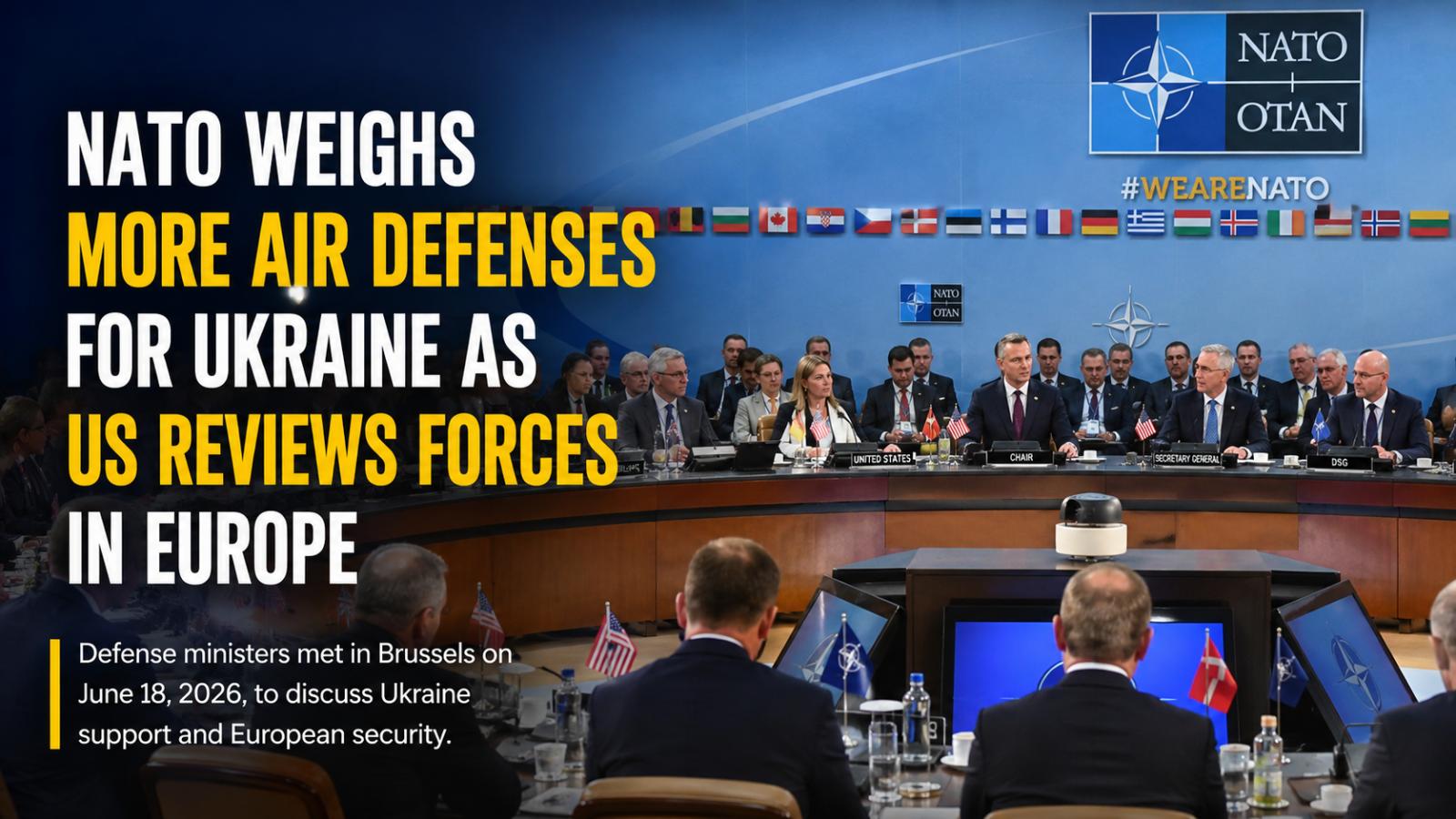
BRUSSELS — A US troop review in Europe is reshaping NATO discussions over Ukraine’s air defenses and the alliance’s long-term security responsibilities. Defense ministers meeting in Brussels on Thursday, June 18, 2026, considered additional weapons, missile interceptors and air-defense support for Ukraine as Washington began reassessing the scale and structure of American military deployments across Europe. US Troop Review in Europe Puts Pressure on NATO All
US Troop Review in Europe Shapes NATO Ukraine Air Defense Talks
BRUSSELS — A US troop review in Europe is reshaping NATO discussions over Ukraine’s air defenses and the alliance’s long-term security responsibilities. Defense ministers meeting in Brussels on Thursday, June 18, 2026, considered additional weapons, missile interceptors and air-defense support for Ukraine as Washington began reassessing the scale and structure of American military deployments across Europe. US Troop Review in Europe Puts Pressure on NATO All
Taiwan presses US for $14bn arms approval amid China tensions
Taiwan has renewed its push for approval of a proposed $14 billion defense package from the United States, arguing that its security environment has become increasingly unstable. The request comes at a time when military activity and political messaging across the Taiwan Strait have intensified, placing additional pressure on Washington’s strategic decision-making. US officials are currently evaluating the proposal through standard defense export channels, weighing supply constrai
Taiwan presses US for $14bn arms approval amid China tensions
Taiwan has renewed its push for approval of a proposed $14 billion defense package from the United States, arguing that its security environment has become increasingly unstable. The request comes at a time when military activity and political messaging across the Taiwan Strait have intensified, placing additional pressure on Washington’s strategic decision-making. US officials are currently evaluating the proposal through standard defense export channels, weighing supply constrai
Pentagon reverts Indo-Pacific Command to US Pacific Command title
US Restores Pacific Command Name in Symbolic Military Rebranding The United States Department of War has officially renamed its largest military command, reverting the Indo-Pacific Command back to its original designation, US Pacific Command. The announcement was made on Tuesday, June 16,2026 with officials confirming that the change is symbolic and will not alter operational responsibilities, deployment st
Pentagon reverts Indo-Pacific Command to US Pacific Command title
US Restores Pacific Command Name in Symbolic Military Rebranding The United States Department of War has officially renamed its largest military command, reverting the Indo-Pacific Command back to its original designation, US Pacific Command. The announcement was made on Tuesday, June 16,2026 with officials confirming that the change is symbolic and will not alter operational responsibilities, deployment st
Pentagon Air Quality Issue Prompts Shelter-in-Place, Hazmat Response
A Pentagon air quality issue prompted a shelter-in-place order and hazardous materials response on Thursday, June 11, 2026, officials said. The response involved Arlington County Fire and EMS units, including the department’s Hazardous Materials Team, supporting the Pentagon Force Protection Agency’s Hazmat Team during what officials described as a hazardous materials incident. Pentagon Air Quality Issue Triggers Shelter-in-Pl
Pentagon Air Quality Issue Prompts Shelter-in-Place, Hazmat Response
A Pentagon air quality issue prompted a shelter-in-place order and hazardous materials response on Thursday, June 11, 2026, officials said. The response involved Arlington County Fire and EMS units, including the department’s Hazardous Materials Team, supporting the Pentagon Force Protection Agency’s Hazmat Team during what officials described as a hazardous materials incident. Pentagon Air Quality Issue Triggers Shelter-in-Pl
US launches self-defense strikes on Iran amid rising tensions
Defensive Strikes Ordered by Trump The United States executed a fresh round of military strikes on multiple Iranian targets on June 10,2026. CENTCOM described the operation as “self-defense,” targeting surveillance systems, communication networks, and air defense sites at the direction of President Donald Trump. US Marine Corps, Air Force, and Navy assets used precision munitions to neutralize threats
US launches self-defense strikes on Iran amid rising tensions
Defensive Strikes Ordered by Trump The United States executed a fresh round of military strikes on multiple Iranian targets on June 10,2026. CENTCOM described the operation as “self-defense,” targeting surveillance systems, communication networks, and air defense sites at the direction of President Donald Trump. US Marine Corps, Air Force, and Navy assets used precision munitions to neutralize threats
Pakistan Satellite Surge With China Support Raises India Security Concerns
Pakistan’s rapid satellite expansion with Chinese support is raising fresh security concerns in India, as analysts warn that the South Asian rivalry is increasingly moving into space. More than a year after India launched Operation Sindoor on Wednesday, May 7, 2025, following the Pahalgam terror attack on Tuesday, April 22, 2025, a quieter contest is unfolding hundreds of kilometers above Earth. Pakistan Expands Earth-Observation Satellite Network
Pakistan Satellite Surge With China Support Raises India Security Concerns
Pakistan’s rapid satellite expansion with Chinese support is raising fresh security concerns in India, as analysts warn that the South Asian rivalry is increasingly moving into space. More than a year after India launched Operation Sindoor on Wednesday, May 7, 2025, following the Pahalgam terror attack on Tuesday, April 22, 2025, a quieter contest is unfolding hundreds of kilometers above Earth. Pakistan Expands Earth-Observation Satellite Network
Israel-Iran Tensions Spike After Ceasefire Break, Strikes Exchange
The fragile calm between Israel and Iran shattered as both nations launched attacks targeting key infrastructure. For the first time since their April ceasefire, strikes on petrochemical and industrial sites in Mahshahr and Haifa have escalated tensions in the Middle East. International observers are warning of broader consequences for regional security and global energy supply. Mahshahr and Haifa Facilities Hit
Israel-Iran Tensions Spike After Ceasefire Break, Strikes Exchange
The fragile calm between Israel and Iran shattered as both nations launched attacks targeting key infrastructure. For the first time since their April ceasefire, strikes on petrochemical and industrial sites in Mahshahr and Haifa have escalated tensions in the Middle East. International observers are warning of broader consequences for regional security and global energy supply. Mahshahr and Haifa Facilities Hit
US Blocks Iranian Military Tech Network Over Deceptive Procurement
The United States announced new sanctions against an Iranian network involved in procuring advanced military technology through deceptive practices. The network reportedly misrepresented itself as legitimate companies, acquiring critical equipment such as spectrum analysers and security devices for Iran’s defense programs. The sanctions reflect Washington’s ongoing effort to restrict Iran’s access to sensitive military technology.
US Blocks Iranian Military Tech Network Over Deceptive Procurement
The United States announced new sanctions against an Iranian network involved in procuring advanced military technology through deceptive practices. The network reportedly misrepresented itself as legitimate companies, acquiring critical equipment such as spectrum analysers and security devices for Iran’s defense programs. The sanctions reflect Washington’s ongoing effort to restrict Iran’s access to sensitive military technology.
Iran tensions lift oil, AI, defense stocks worldwide
Recent developments in Iran have sent shockwaves through global financial markets. Investors are recalibrating portfolios as oil prices climb, geopolitical uncertainty rises, and economic pressures mount. While energy producers, defense companies, and AI-driven technology firms see gains, sectors like airlines and energy-importing economies face increasing strain. The US dollar and other safe-haven assets are also attracting attention amid market volatility.
Iran tensions lift oil, AI, defense stocks worldwide
Recent developments in Iran have sent shockwaves through global financial markets. Investors are recalibrating portfolios as oil prices climb, geopolitical uncertainty rises, and economic pressures mount. While energy producers, defense companies, and AI-driven technology firms see gains, sectors like airlines and energy-importing economies face increasing strain. The US dollar and other safe-haven assets are also attracting attention amid market volatility.
Pentagon Releases New UFO Files with Green Orbs and Fireballs
Pentagon Releases Declassified UFO Files The US Defense Department has released a new batch of previously classified files detailing alleged sightings of unidentified flying objects (UFOs). Among the reports are references to unusual aerial phenomena, including green orbs and fireballs, which have been observed by military personnel across various locations. These newly released files provide additional insight into the mil
Pentagon Releases New UFO Files with Green Orbs and Fireballs
Pentagon Releases Declassified UFO Files The US Defense Department has released a new batch of previously classified files detailing alleged sightings of unidentified flying objects (UFOs). Among the reports are references to unusual aerial phenomena, including green orbs and fireballs, which have been observed by military personnel across various locations. These newly released files provide additional insight into the mil
Trump Sends 5,000 More US Troops To Poland Amid NATO Tensions
Trump Announces New Poland Troop Deployment US President Donald Trump said Thursday,May 21,2026 that the United States will deploy 5,000 additional troops to Poland, reversing earlier indications that a planned deployment had been canceled. Trump announced the decision on Truth Social and said it was influenced by his relationship with Polish President Karol Nawrocki, a nationalist ally whom he supported during last year’
Trump Sends 5,000 More US Troops To Poland Amid NATO Tensions
Trump Announces New Poland Troop Deployment US President Donald Trump said Thursday,May 21,2026 that the United States will deploy 5,000 additional troops to Poland, reversing earlier indications that a planned deployment had been canceled. Trump announced the decision on Truth Social and said it was influenced by his relationship with Polish President Karol Nawrocki, a nationalist ally whom he supported during last year’
China Admits Pakistan J-10C Support During Operation Sindoor
China’s rare admission raises stakes China has admitted its engineers supported Pakistan’s J-10C fighter jet operations during India’s Operation Sindoor in May 2025, a disclosure that adds a sharper China angle to the India-Pakistan conflict. The admission came through Chinese state broadcaster CCTV, where AVIC engineer Zhang Heng described being at a support base as fighter jets took off and air-raid sirens sounded. He said the team worked in extreme May heat while trying to keep Chinese-made equipment combat-ready. Why the J-10C disclosure matters The J-10CE, Pakistan’s export version of China’s J-10C multirole fighter, is central to the story because Pakistan remains its only foreign operator. The aircraft is linked to advanced AESA radar and PL-15 long-range air-to-air missiles, making any wartime support politically sensitive. Indian defence officials have said Operation Sindoor targeted terror infrastructure after the Pahalgam attack, while later briefings claimed 13 Pakistani aircraft and 11 airfields were hit. Those claims, combined with Beijing’s acknowledgement of technical support, are likely to intensify scrutiny of the China-Pakistan defence partnership. Regional security impact The timing is significant. The disclosure surfaced around the first anniversary of Operation Sindoor and reinforces India’s long-held concern that Pakistan’s military capability is increasingly backed by Chinese systems, engineers and supply chains. For New Delhi, the key question is no longer whether Chinese weapons were used, but how deeply Chinese personnel supported Pakistan during active conflict. That makes this admission more than a defence update—it is a fresh flashpoint in Asian security.
China Admits Pakistan J-10C Support During Operation Sindoor
China’s rare admission raises stakes China has admitted its engineers supported Pakistan’s J-10C fighter jet operations during India’s Operation Sindoor in May 2025, a disclosure that adds a sharper China angle to the India-Pakistan conflict. The admission came through Chinese state broadcaster CCTV, where AVIC engineer Zhang Heng described being at a support base as fighter jets took off and air-raid sirens sounded. He said the team worked in extreme May heat while trying to keep Chinese-made equipment combat-ready. Why the J-10C disclosure matters The J-10CE, Pakistan’s export version of China’s J-10C multirole fighter, is central to the story because Pakistan remains its only foreign operator. The aircraft is linked to advanced AESA radar and PL-15 long-range air-to-air missiles, making any wartime support politically sensitive. Indian defence officials have said Operation Sindoor targeted terror infrastructure after the Pahalgam attack, while later briefings claimed 13 Pakistani aircraft and 11 airfields were hit. Those claims, combined with Beijing’s acknowledgement of technical support, are likely to intensify scrutiny of the China-Pakistan defence partnership. Regional security impact The timing is significant. The disclosure surfaced around the first anniversary of Operation Sindoor and reinforces India’s long-held concern that Pakistan’s military capability is increasingly backed by Chinese systems, engineers and supply chains. For New Delhi, the key question is no longer whether Chinese weapons were used, but how deeply Chinese personnel supported Pakistan during active conflict. That makes this admission more than a defence update—it is a fresh flashpoint in Asian security.
Iran ‘Explosive Dolphin’ Claims Rejected as Hormuz Tensions Rise
Pentagon Rejects Iran Dolphin Weapon Claims The Pentagon has dismissed claims that Iran is training explosive dolphins, confirming there is no credible evidence of such a program. Officials addressed the rumors as tensions in the Strait of Hormuz continue to escalate. Speaking on May 6, 2026, U.S. Defense Secretary Pete Hegseth said reports of “kamikaze dolphins” are unfounded. “Iran does not have such capabilities,” he stated, r
Iran ‘Explosive Dolphin’ Claims Rejected as Hormuz Tensions Rise
Pentagon Rejects Iran Dolphin Weapon Claims The Pentagon has dismissed claims that Iran is training explosive dolphins, confirming there is no credible evidence of such a program. Officials addressed the rumors as tensions in the Strait of Hormuz continue to escalate. Speaking on May 6, 2026, U.S. Defense Secretary Pete Hegseth said reports of “kamikaze dolphins” are unfounded. “Iran does not have such capabilities,” he stated, r
Modern Air Combat: F-35 Sensor Fusion Meets F-15IA Payload Strength
Modern air combat strategy increasingly relies on the complementary strengths of advanced fighter aircraft, particularly the combination of stealth capabilities and high payload capacity. The F-35 and F-15IA represent this dual approach, where each platform fulfills a distinct but interconnected role in complex operations. The F-35 is designed for stealth and precision, enabling it to operate deep within contested airspace while avoiding detection. Its ability to gather and process battlefield data in real time allows it to identify and track threats with high accuracy. This sensor fusion capability creates a comprehensive operational picture, which can be shared seamlessly with other aircraft to improve coordination and targeting efficiency. In contrast, the F-15IA is built for power and endurance. Often described as a high-capacity weapons platform, it can carry a significantly larger payload compared to stealth-focused aircraft. Once air defenses are identified and weakened, the F-15IA can engage multiple targets using a wide range of munitions, including larger weapons that are not compatible with stealth aircraft configurations. Its advanced radar system enhances its ability to detect and engage threats over extended distances. The combination of these aircraft also supports long-range missions. The F-15IA’s extended range and fuel capacity make it well-suited for operations requiring sustained flight over large distances. This allows it to conduct deep strike missions with fewer refueling requirements, complementing the F-35’s forward reconnaissance and targeting role. Operational efficiency is another key factor in this pairing. The F-15IA is designed for durability and rapid turnaround, enabling frequent sorties during extended engagements. Meanwhile, the F-35’s advanced systems provide critical intelligence that enhances the effectiveness of each mission. Together, they form a coordinated system that balances stealth, firepower, and operational flexibility in modern aerial warfare.
Modern Air Combat: F-35 Sensor Fusion Meets F-15IA Payload Strength
Modern air combat strategy increasingly relies on the complementary strengths of advanced fighter aircraft, particularly the combination of stealth capabilities and high payload capacity. The F-35 and F-15IA represent this dual approach, where each platform fulfills a distinct but interconnected role in complex operations. The F-35 is designed for stealth and precision, enabling it to operate deep within contested airspace while avoiding detection. Its ability to gather and process battlefield data in real time allows it to identify and track threats with high accuracy. This sensor fusion capability creates a comprehensive operational picture, which can be shared seamlessly with other aircraft to improve coordination and targeting efficiency. In contrast, the F-15IA is built for power and endurance. Often described as a high-capacity weapons platform, it can carry a significantly larger payload compared to stealth-focused aircraft. Once air defenses are identified and weakened, the F-15IA can engage multiple targets using a wide range of munitions, including larger weapons that are not compatible with stealth aircraft configurations. Its advanced radar system enhances its ability to detect and engage threats over extended distances. The combination of these aircraft also supports long-range missions. The F-15IA’s extended range and fuel capacity make it well-suited for operations requiring sustained flight over large distances. This allows it to conduct deep strike missions with fewer refueling requirements, complementing the F-35’s forward reconnaissance and targeting role. Operational efficiency is another key factor in this pairing. The F-15IA is designed for durability and rapid turnaround, enabling frequent sorties during extended engagements. Meanwhile, the F-35’s advanced systems provide critical intelligence that enhances the effectiveness of each mission. Together, they form a coordinated system that balances stealth, firepower, and operational flexibility in modern aerial warfare.
Why the US Rushed $8.6B Arms Deal to Middle East Allies Amid Iran Crisis
The United States has fast-tracked more than $8.6 billion in arms sales to key Middle East allies, signaling a sharp escalation in its response to rising tensions with Iran. Approved under emergency powers, the move bypasses Congress and reflects Washington’s urgency to strengthen regional defenses as the conflict enters a critical phase. Emergency Approval Signals Rising Urgency The decision, issued on Friday, invokes a rarely used em
Why the US Rushed $8.6B Arms Deal to Middle East Allies Amid Iran Crisis
The United States has fast-tracked more than $8.6 billion in arms sales to key Middle East allies, signaling a sharp escalation in its response to rising tensions with Iran. Approved under emergency powers, the move bypasses Congress and reflects Washington’s urgency to strengthen regional defenses as the conflict enters a critical phase. Emergency Approval Signals Rising Urgency The decision, issued on Friday, invokes a rarely used em


