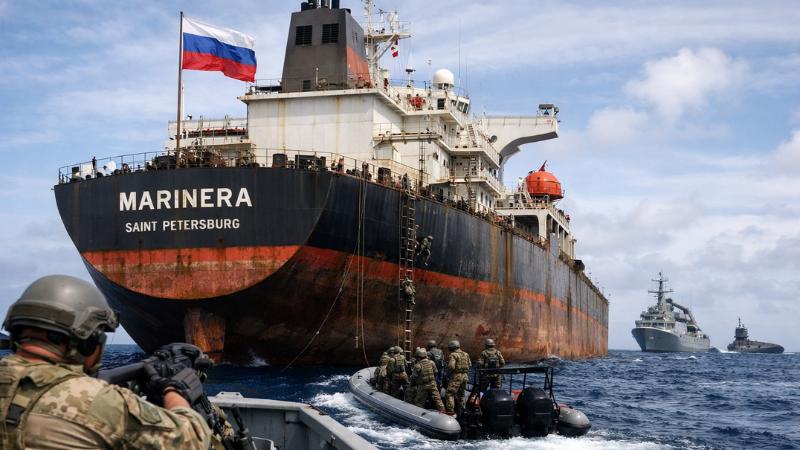
The United States has seized a Russia-flagged oil tanker in the North Atlantic, escalating enforcement of American sanctions and drawing attention to an unusual maritime confrontation involving Russian military assets. The vessel, originally known as Bella-1, was taken into custody on Wednesday following a coordinated operation by US civilian and military authorities acting under a federal court warrant.
According to official statements, the seizure was carried out after the tanker was tracked for weeks by the US Coast Guard. The operation involved cooperation between the Departments of Justice and Homeland Security, with logistical and operational support from US military commands in Europe. Authorities said the action was based on violations of US sanctions targeting vessels engaged in illicit oil transport linked to hostile actors.
The tanker was reportedly operating under the protection of Russian naval forces at the time of the seizure, with surface warships and a submarine present in the surrounding area. US officials acknowledged the presence of Russian military assets but stated that the operation proceeded without direct confrontation. The seizure was described as part of a broader effort to counter sanctioned maritime activity that US authorities say threatens regional stability.
Officials said the move aligns with a presidential proclamation aimed at blocking the movement of sanctioned vessels in the Western Hemisphere. The operation was characterized as a whole-of-government effort designed to enforce economic restrictions and protect US national security interests. The tanker was intercepted in international waters after a warrant was issued by a US federal court authorizing its seizure.
The vessel has been under scrutiny since last month, when it evaded a US maritime blockade near Venezuela. During that episode, the tanker was unable to dock and load oil due to continued surveillance, eventually slipping past enforcement efforts while empty. An earlier attempt to board the ship was unsuccessful, prompting an extended pursuit by US authorities.
Following its escape from the blockade, the ship changed its registration and began sailing under a Russian flag, adopting the new name Marinera. US officials later reported that the vessel was heading north through the Atlantic, passing near Iceland on a route believed to be bound for Russia.
American authorities have alleged that the tanker was involved in transporting black-market oil originating from Iran and Russia, with proceeds benefiting groups designated by the United States as terrorist organizations aligned with the Iranian government. These allegations formed a key basis for the enforcement action taken this week.
After the vessel was re-registered under Russian jurisdiction, Moscow raised concerns over the US pursuit and defended the tanker’s activities. Russian state-linked outlets also disputed the legitimacy of the operation, framing the American action as unjustified. Visual footage circulated by Russian sources purported to show an attempted boarding, though independent verification was not immediately available.
The incident marks a rare point of friction between Washington and Moscow during President Donald Trump’s second term. Despite a broader easing of tensions and renewed diplomatic engagement since January, the tanker seizure underscores persistent disagreements over sanctions enforcement and energy trade.
US officials also confirmed that the Bella-1 was the second Venezuela-linked vessel seized by American authorities within a short span. Earlier on the same day, another oil tanker was intercepted in the Caribbean after allegedly operating under a false foreign flag, highlighting an intensified push by the United States to police maritime sanctions violations across multiple regions.