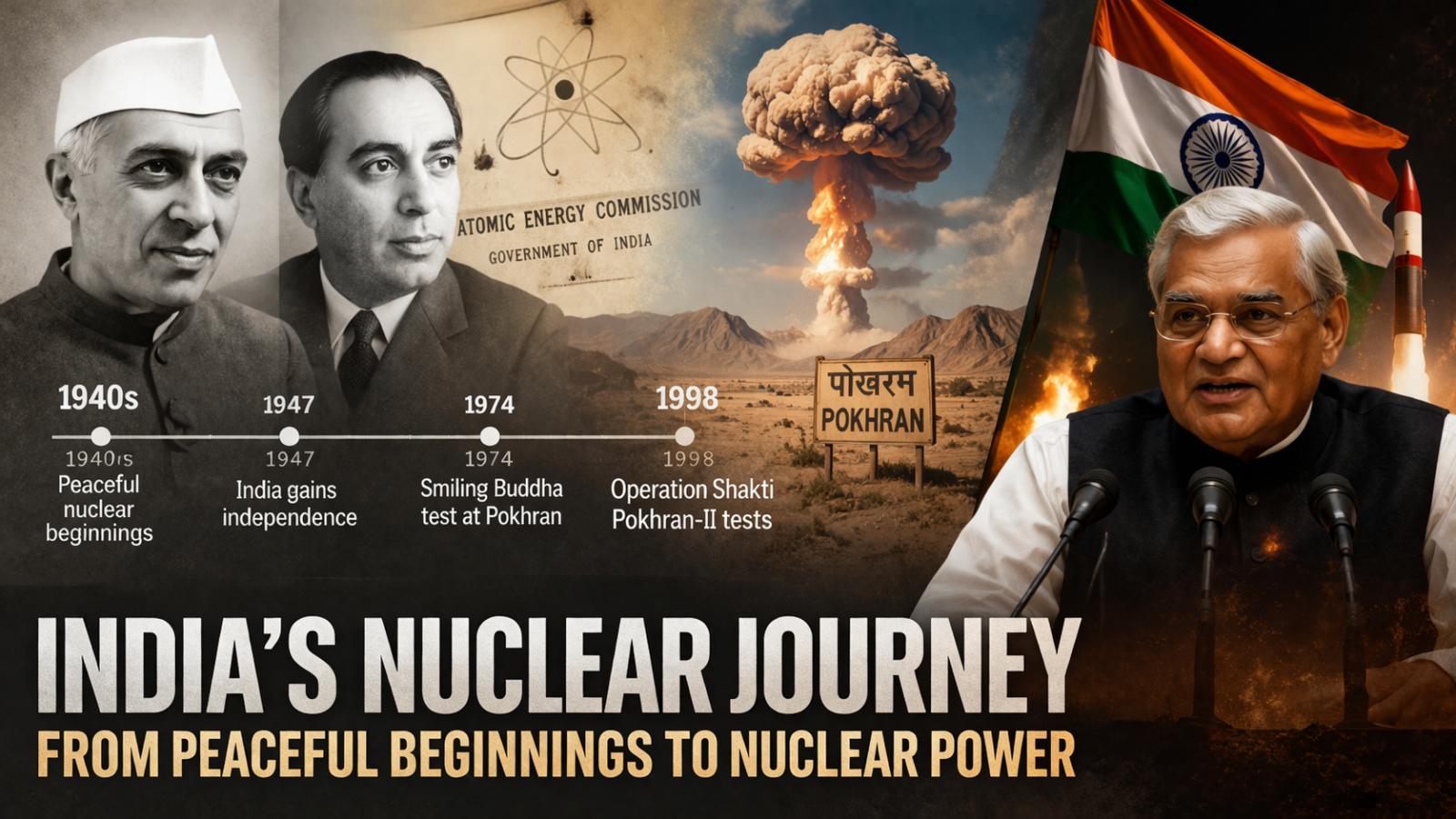
India's journey into nuclear weapons began in the early 1940s under British colonial rule. Following independence in 1947, the country embarked on a peaceful nuclear program primarily focused on energy production. At the helm of the program was Prime Minister Jawaharlal Nehru, who aimed to harness nuclear energy for civilian use, emphasizing the peaceful applications of atomic power. However, the political landscape began shifting in the 1960s as India faced mounting security concerns, particularly from neighboring China and Pakistan.
The foundation for India's nuclear weapons program was laid by Dr. Homi J. Bhabha, an influential nuclear physicist. His pioneering research in atomic energy provided the groundwork for India's nuclear ambitions. With support from the Indian government, Bhabha's work initiated the development of the country's nuclear infrastructure. Initially, India's nuclear ambitions were covert, with assistance from global powers like the Soviet Union. However, by the 1970s, India had developed the technological capacity to produce nuclear weapons independently.
The pivotal moment came in 1974, when India successfully conducted its first nuclear test, codenamed Smiling Buddha, at the Pokhran Test Range in Rajasthan. This test marked a significant milestone in India's nuclear development under the leadership of Prime Minister Indira Gandhi. The test, which was kept secret until after it was conducted, showcased India’s growing nuclear capabilities and its determination to establish a deterrent against its regional adversaries.
Following the success of the Smiling Buddha test, India maintained a policy of "No First Use" (NFU), committing to not initiate the use of nuclear weapons but reserving the right to use them in retaliation. Despite this, India continued to enhance its nuclear deterrence capabilities throughout the 1980s and 1990s. The program remained discreet for several years, with the country focusing on strengthening its nuclear arsenal.
It was in 1998, under the leadership of Prime Minister Atal Bihari Vajpayee, that India officially declared itself a nuclear power. This declaration was made following a series of nuclear tests, known as Operation Shakti, which were again conducted at the Pokhran Test Range. The tests, which included five nuclear explosions, confirmed India's nuclear capability and solidified its status as a global nuclear power. With this move, India demonstrated its commitment to safeguarding its national security, particularly amid the ongoing tensions with neighboring countries.
Thus, India's nuclear journey has been shaped by decades of scientific research, security concerns, and political leadership. From a peaceful nuclear program to becoming a declared nuclear power, India's nuclear trajectory has had profound implications for the country's role in global geopolitics. India’s nuclear capability, built over several decades, continues to influence the nation’s security strategy, asserting its position as a prominent nuclear power in the world today.