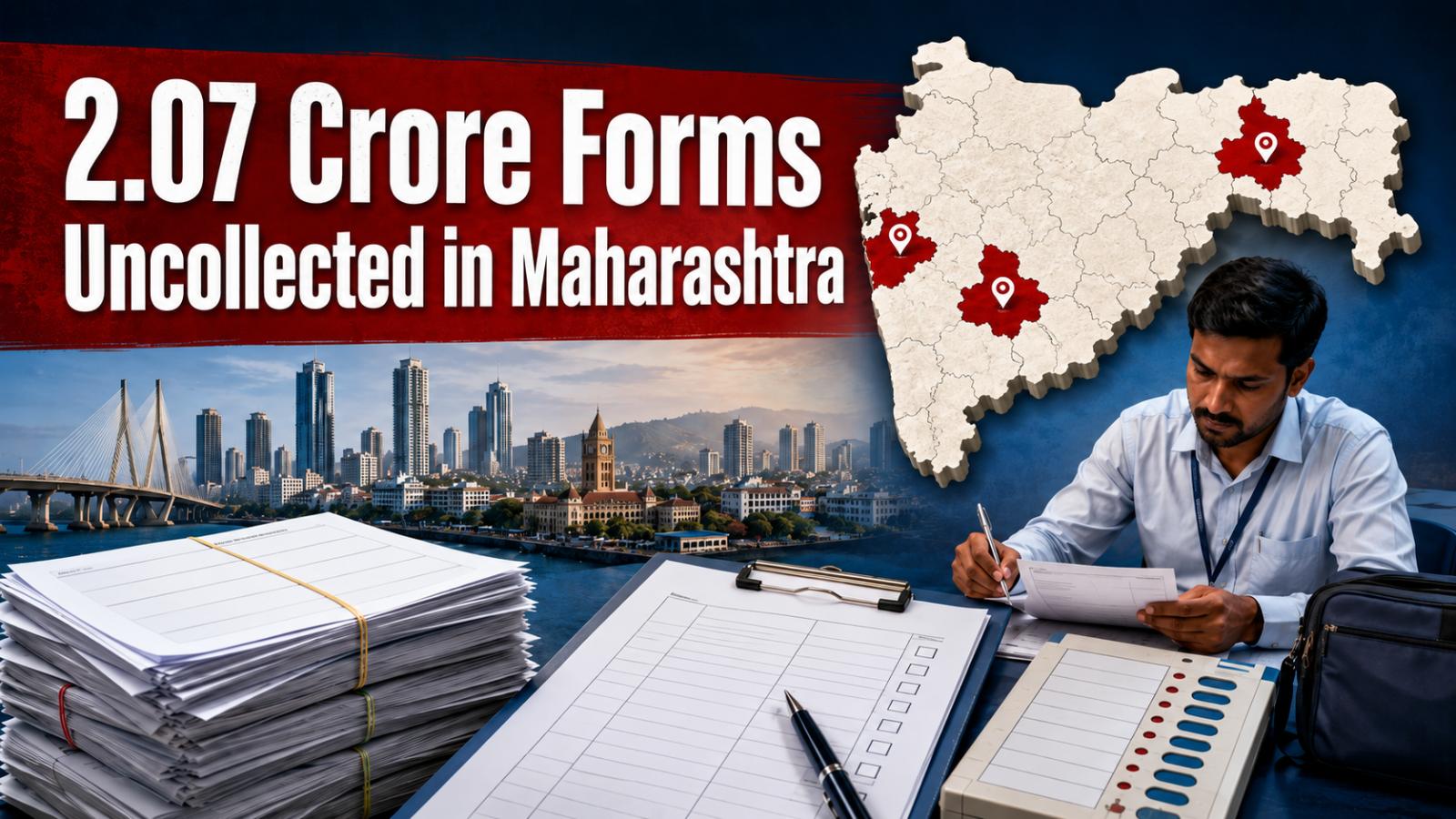
More than 2.07 crore Maharashtra SIR voter forms remained uncollected at the end of the enumeration exercise, bringing voter verification into focus before the state publishes its draft electoral roll. The scale is significant because Maharashtra has nearly 9.8 crore registered voters, while Mumbai SIR, Thane SIR and Pune SIR account for a large share of the pending forms.
The Special Intensive Revision, conducted under the Election Commission of India, uses Booth Level Officers to verify voter details through house-to-house enumeration. The process seeks to update the electoral roll by identifying people who have shifted, died, cannot be traced at their registered address or may have duplicate entries. The Election Commission’s voter portal also provides services for registration, deletion and correction of electoral details.
Mumbai SIR and urban voter verification
Mumbai, Thane and Pune have emerged as the biggest pressure points in Maharashtra’s verification drive. Thane, Mumbai City, Mumbai Suburban and Pune together account for about 94.47 lakh uncollected enumeration forms, or roughly 45.4% of Maharashtra’s total.
Pune recorded around 28.99 lakh uncollected forms, while Thane had about 28.88 lakh. Mumbai Suburban accounted for around 26.99 lakh and Mumbai City about 9.60 lakh. The concentration highlights the difficulty of verifying voters in densely populated areas where migration, rental housing and frequent address changes are common.
Around 30 lakh Mumbai voters had also been reported as untraced earlier in the exercise. However, an uncollected form should not automatically be interpreted as confirmation that a voter has been deleted from the electoral roll.
Nagpur SIR adds to verification challenge
Nagpur is another district facing a substantial verification gap. Around 13.36 lakh voters in Nagpur district were placed in the uncollectable category during the enumeration stage.
The figures create an important distinction for election officials: some records may relate to voters who have permanently shifted, died or have duplicate registrations, while others may involve eligible voters who were simply unavailable when a BLO visited.
The Election Commission describes electoral roll revision as a process that includes identifying multiple, shifted and deceased electors while providing a formal claims and objections mechanism after publication of the draft roll.
Maharashtra draft roll becomes crucial next step
The next stage will be particularly important for Maharashtra voters who could not complete verification. Once the draft electoral roll is published, citizens should check whether their names and details appear correctly rather than assuming their previous registration remains unchanged.
The Chief Electoral Officer, Maharashtra, is handling the state’s SIR 2026 programme under Election Commission guidelines, while the official voter services portal allows citizens to search electoral records and submit the relevant forms for registration or correction.
Claims and objections offer voters another opportunity
Publication of the draft roll does not end the revision process. Election Commission procedures provide a claims and objections stage during which eligible citizens can seek inclusion, challenge incorrect entries or request corrections before the electoral roll is finalised.
For Maharashtra, the bigger challenge is balancing electoral roll accuracy with voter inclusion. Removing outdated or duplicate records is necessary, but the unusually high number of uncollected forms means authorities must also ensure that eligible voters are not excluded simply because they could not be reached during door-to-door verification.
With a major portion of the pending Maharashtra SIR voter forms concentrated in Mumbai, Thane and Pune, urban voter verification is likely to remain the key issue as the state moves from enumeration to scrutiny, claims and finalisation of its revised electoral roll.