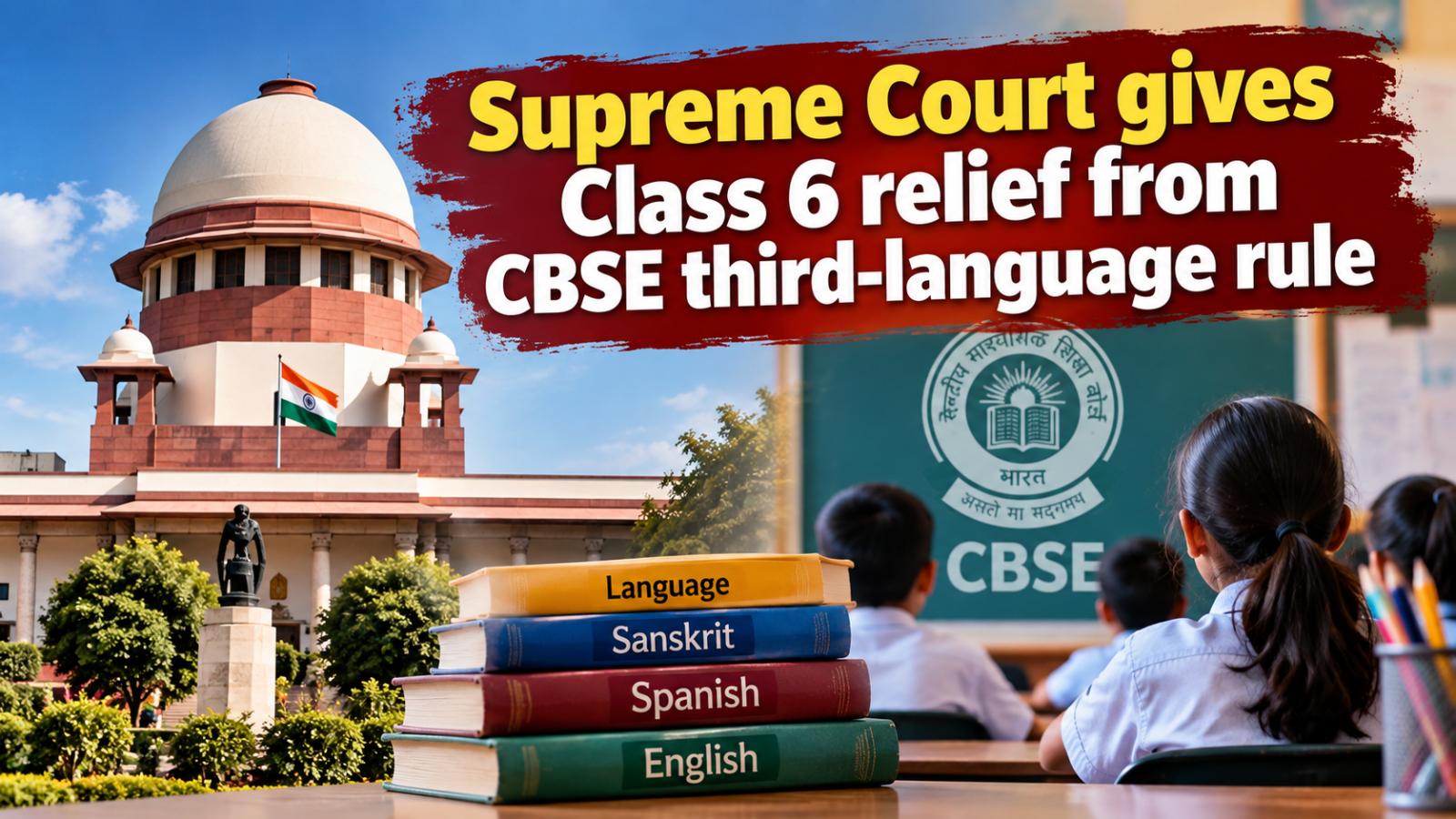
The Supreme Court has directed CBSE to extend relief from the three-language requirement to students currently studying in Class 6, bringing them in line with students in Classes 7, 8 and 9 who had already received similar protection. The court said the present Class 6 batch should not be forced to immediately adapt to the revised language framework and directed that implementation for these students begin from April 1, 2027.
The order came while the court was hearing petitions challenging the implementation of CBSE’s three-language framework. The Centre had argued that Class 6 students should continue with the new system during the current academic year, saying that around 99 per cent of the schools concerned had adopted the policy and had the necessary facilities. According to the government’s submission, only a small percentage of schools were facing difficulties.
CBSE third-language policy implementation delayed for Class 6
Despite the Centre’s position, the Supreme Court said the current Class 6 batch should receive the same comfort already extended to older students. Justice Joymalya Bagchi observed that the objective should not be to make students repeatedly adjust to sudden academic changes simply because they are capable of doing so.
The larger dispute involves CBSE’s revised curriculum aligned with the National Education Policy 2020 and the National Curriculum Framework. Under the framework, students from Class 6 onward are expected to study three languages, with at least two of them being Indian languages. The policy has been presented as an effort to strengthen multilingual learning, while some parents and schools have raised concerns about how abruptly it has been introduced.
Parents told the court that some students had already been studying foreign languages such as Spanish for several years and were now being required to switch to languages such as Sanskrit. Their argument focused on continuity in education rather than opposition to any particular language.
Third-language textbook concerns raised before Supreme Court
The petitioners also highlighted concerns over the availability of textbooks and learning resources. Lawyers representing parents said some required books were not physically available to students even though authorities maintained that learning material was accessible.
Questions were also raised about how English is classified within the revised language framework, particularly for students studying in English-medium schools. The petitioners argued that language choices should remain consistent with constitutional principles and the flexibility promised under the National Education Policy.
The Supreme Court has not yet delivered a final ruling on the validity of the broader three-language policy. The current direction is limited to protecting the existing Class 6 batch from immediate implementation while the larger legal questions are examined.
The matter has been posted for further hearing after six weeks. The court has asked for additional filings from the parties before it continues examining the wider challenge to CBSE’s language framework. For the present Class 6 batch, however, the immediate impact is clear: the mandatory requirement will not take effect until April 1, 2027.