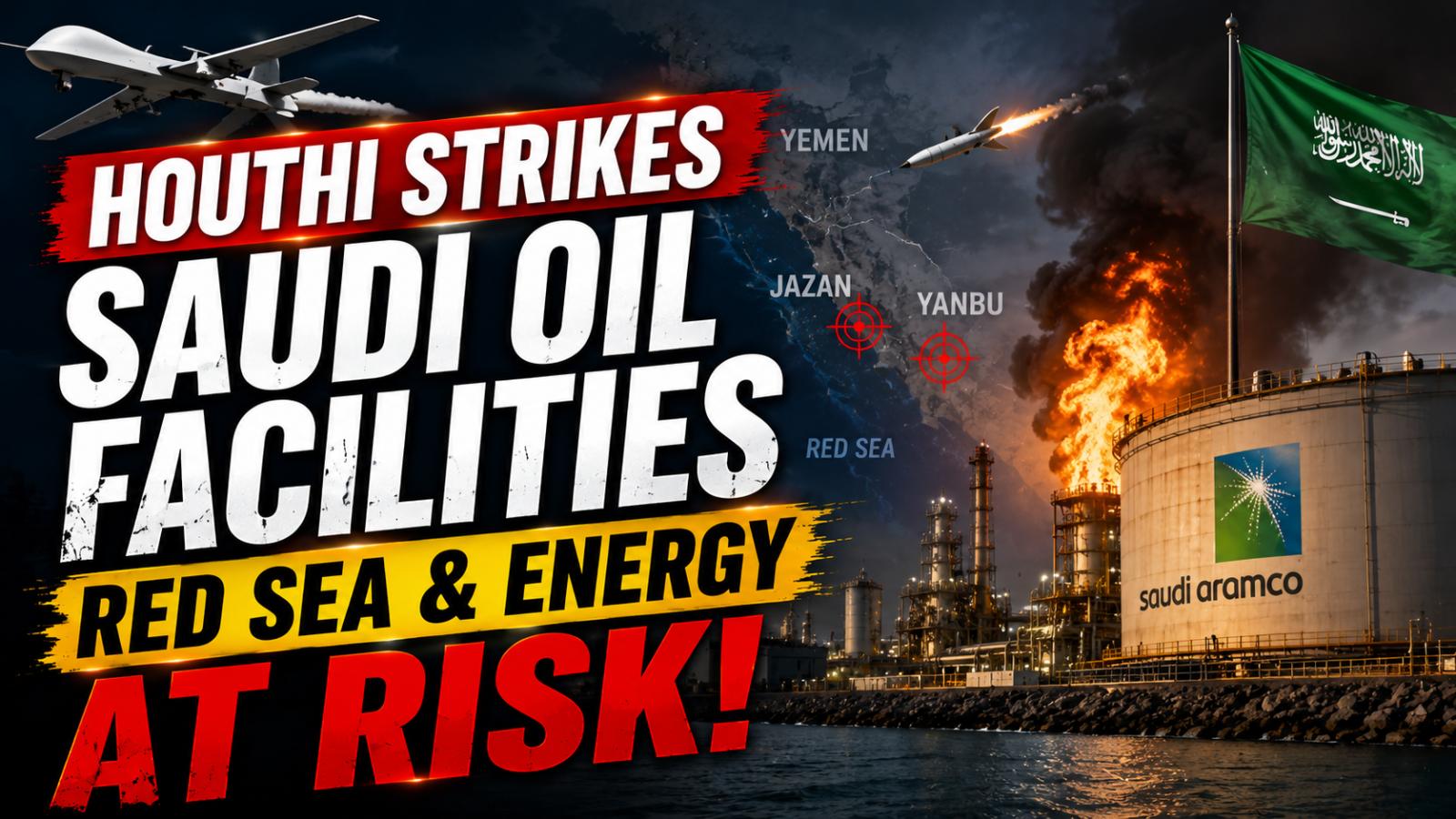
Houthi Saudi Aramco attack claims have intensified concerns over Middle East stability after the Iran-backed group said it targeted key Saudi oil facilities in Jazan and Yanbu. The reported strikes, coupled with claims of downing a Saudi drone and Iran's announcement that it has paused retaliatory operations, have added fresh uncertainty to regional security and global energy markets.
Houthi Saudi Aramco attack claims target key oil infrastructure
Iran-backed Houthi rebels claimed on July 25 that they launched missiles and drones at Saudi Aramco facilities in Jazan and Yanbu, describing the operation as retaliation for recent Saudi-led airstrikes on Houthi-controlled areas along Yemen's Red Sea coast. The group's military spokesperson, Yahya Saree, said the attacks were intended to respond to what it described as continued military operations by the Saudi-led coalition.
Saudi Arabia has not officially confirmed that its oil facilities were struck. While several videos and images have circulated online claiming to show the aftermath, Saudi authorities have not verified the authenticity of the material or reported damage to energy infrastructure.
The reported targets are strategically significant. Jazan hosts one of Saudi Arabia's major oil refineries, while Yanbu serves as an important export terminal on the Red Sea. Oil shipped through Yanbu bypasses the Strait of Hormuz, giving Saudi Arabia an alternative route for exports during periods of heightened tension in the Gulf.
Yanbu port and Red Sea shipping under renewed pressure
Analysts say that if Yanbu were successfully targeted, the implications could extend well beyond Saudi Arabia. The facility has become increasingly important because it allows crude oil exports to avoid the Strait of Hormuz, one of the world's busiest and most strategically sensitive maritime chokepoints.
By threatening infrastructure on the Red Sea coast, the Houthis appear to be expanding the conflict beyond the Persian Gulf. Any disruption to both the Strait of Hormuz and Red Sea shipping routes could increase risks to global energy supplies and place additional pressure on international oil markets.
Yahya Saree warned that the group's military operations could increase in scale and intensity "in the coming hours and days," raising concerns that further attacks could target additional strategic infrastructure.
Houthi drone claim follows Saudi-led airstrikes
Later on the same day, the Houthis announced that they had shot down a Saudi reconnaissance drone over northwestern Yemen. According to Saree, the aircraft was a Turkish-made armed surveillance drone that was conducting what he described as hostile operations.
The claim has not been independently verified by Saudi officials. If confirmed, it would represent another escalation following the first Saudi-led airstrikes against Houthi positions since the 2022 ceasefire. Those strikes marked a significant shift after nearly three years of relative military restraint between the two sides.
The renewed exchange of attacks has fueled concerns that the wider confrontation involving Iran, Israel and the United States could draw Yemen back into a broader regional conflict.
Iran says retaliatory operations have paused
Meanwhile, Iran announced on July 26 that it had halted its retaliatory operations after the United States reportedly stopped conducting strikes against Iranian targets over the previous two nights.
Army spokesperson Mohammad Akraminia stated that Iranian actions had been based on a strategy of retaliation and that operations were suspended after US military activity ceased. The statement suggests that Tehran is attempting to signal a temporary reduction in direct military exchanges while leaving open the possibility of future action if circumstances change.
Despite Iran's announcement, uncertainty remains high across the region. Houthi threats against Saudi energy infrastructure, combined with ongoing tensions involving Iran, the United States and Israel, continue to create risks for regional stability. Energy markets will likely remain focused on developments affecting the Strait of Hormuz, Red Sea shipping lanes and Saudi export facilities, as any prolonged disruption could have global economic consequences.