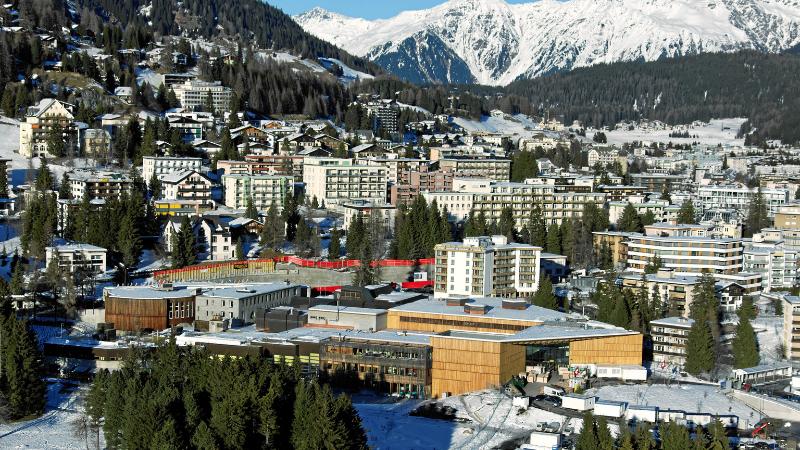
Iran’s Foreign Minister Abbas Araghchi has strongly criticised the World Economic Forum following the cancellation of his scheduled appearance at the organisation’s annual meeting in Davos, accusing the forum of applying inconsistent moral and political standards. The remarks came after the WEF announced that Araghchi would no longer attend the high-profile gathering of political and business leaders in the Swiss resort town.
According to Araghchi, the decision to withdraw his invitation was driven by what he described as false narratives and political pressure exerted by Israel- and United States-based groups. He argued that the move reflected selective judgment rather than a principled stance on human rights, particularly when compared with the continued participation of Israeli officials at the same forum despite the ongoing conflict in Gaza.
In a statement shared on social media, the Iranian foreign minister said the WEF’s actions revealed a “blatant double standard” and accused the organisation of moral inconsistency. He asserted that if the forum intended to adopt a moral position, it should do so in a uniform manner rather than singling out specific governments. Araghchi added that the approach taken by the organisers undermined their credibility and conveyed what he called intellectual and ethical failure.
The WEF, for its part, confirmed that Araghchi would not be attending the Davos meeting this year. In an official message, the organisation said that although the Iranian foreign minister had been invited months earlier, the recent loss of civilian lives in Iran made it inappropriate for the Iranian government to be represented at the event. The forum did not comment further on Araghchi’s claims of political pressure or alleged bias.
The cancellation comes amid continued unrest in Iran, where protests have been met with a heavy security response. Human rights groups based outside the country have reported thousands of deaths linked to the crackdown, while warning that the actual number of casualties could be significantly higher. Iranian authorities have disputed such figures and maintain that their actions are aimed at preserving public order and national stability.
Araghchi has repeatedly drawn parallels between the situation in Iran and the conflict in Gaza, arguing that the WEF’s treatment of the two cases highlights unequal standards in international forums. He has pointed to the presence of Israeli leaders at past Davos meetings, including appearances made during periods of intense military operations, as evidence that similar scrutiny has not been applied uniformly.
By linking his disinvitation to broader geopolitical dynamics, Araghchi framed the episode as part of a wider debate over the role of global institutions in shaping narratives around human rights and conflict. He insisted that public opinion should be allowed to assess such decisions independently, without what he described as selective moral positioning by influential international platforms.
The dispute adds to existing tensions between Iran and Western-led institutions, and underscores the challenges faced by global forums attempting to balance political engagement with ethical considerations. As Davos continues without Iranian representation, the controversy surrounding Araghchi’s exclusion is likely to fuel further debate over neutrality, consistency, and accountability in international diplomacy.