A U.S. passport for a child born abroad depends on whether the child acquired U.S. citizenship through a parent. Families may need a CRBA, foreign birth certificate, proof of the parent’s citizenship and U.S. residence history, plus the standard minor passport documents.
A child born outside the United States may qualify for a U.S. passport if the child acquired U.S. citizenship at birth through one or both U.S. citizen parents.
Citizenship is not determined only by the parent’s nationality. The applicable law may also consider the child’s date of birth, the parents’ circumstances and whether the U.S. citizen parent met required U.S. residence or physical-presence rules before the child was born.
Consular Report of Birth Abroad
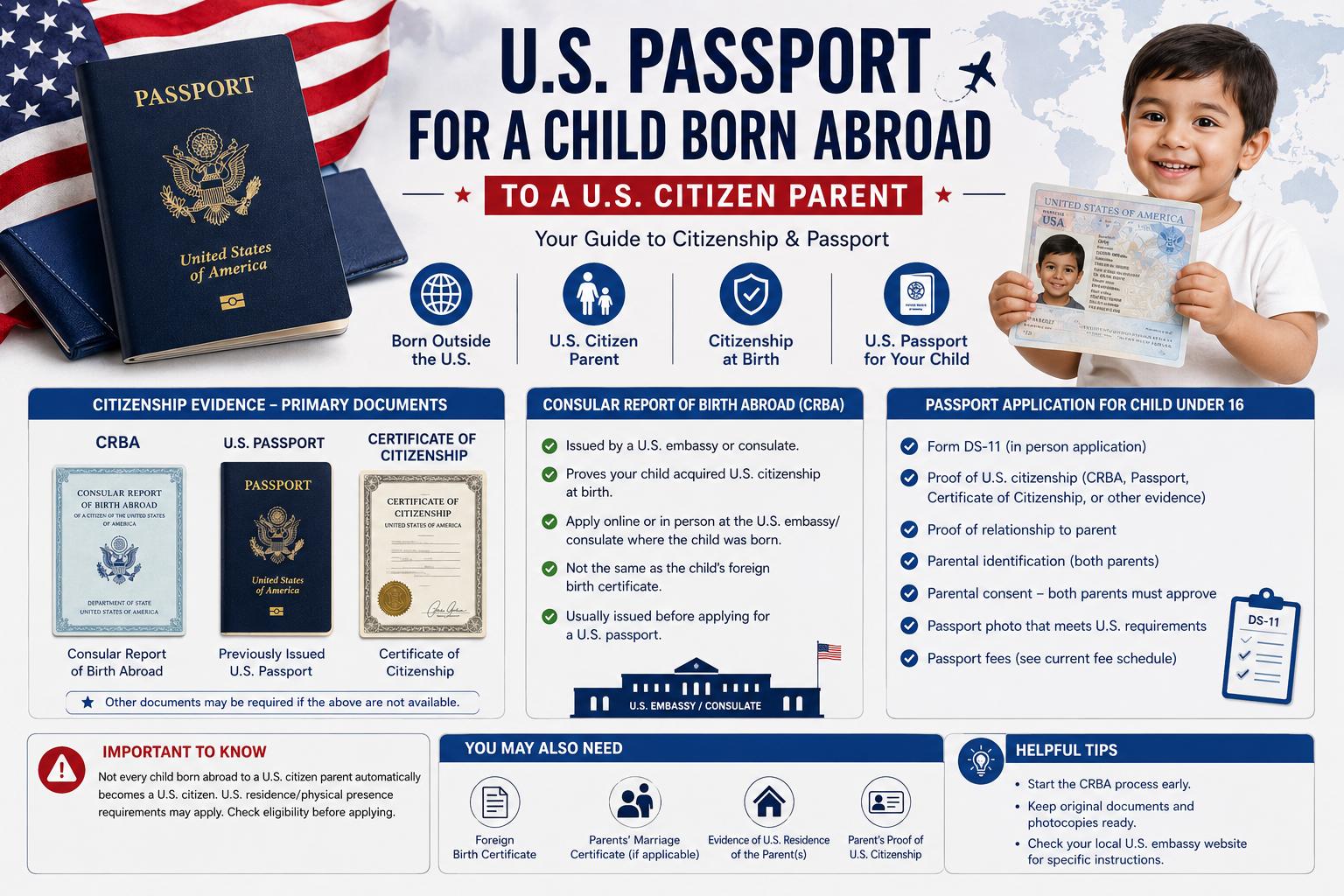
Parents of a qualifying child born overseas can generally apply for a Consular Report of Birth Abroad, or CRBA, through a U.S. embassy or consulate.
Families can review the accepted proof of U.S. citizenship for a child to understand which records may be used for a passport application.
A CRBA documents that the child acquired U.S. citizenship or nationality at birth. The State Department issues CRBAs to qualifying children under age 18. A CRBA is not the child’s foreign birth certificate and does not itself establish legal custody.
Many U.S. embassies and consulates allow families to begin the CRBA process online.
Citizenship Evidence for a Child Born Abroad
A CRBA can serve as primary citizenship evidence when applying for a U.S. passport.
Other primary evidence may include a previously issued full-validity U.S. passport or Certificate of Citizenship.
If the child acquired citizenship at birth but does not have one of these documents, the State Department may require the child’s foreign birth certificate, evidence of the U.S. citizen parent’s citizenship, the parents’ marriage certificate when applicable, and a statement detailing when and where the parents lived in the United States and abroad before the child’s birth.
Passport Application for Children Under 16
Children under 16 generally apply for a passport in person using Form DS-11.
Parents should review the complete U.S. passport requirements for a child under 16 before scheduling the application appointment.
The child must appear with the required parent or guardian, and families must provide citizenship evidence, proof of the parent-child relationship, parental identification, consent documentation and a passport photo.
A full checklist of documents needed for a child’s U.S. passport application can help families prepare before the appointment.
Standard parental-consent requirements still apply even when the child was born overseas.
Additional consent documentation may be necessary when one parent cannot attend the child’s passport appointment.
Does Every Child of a U.S. Citizen Qualify?
Not necessarily. Citizenship transmission rules differ depending on the circumstances surrounding the child’s birth.
For example, the amount of time a U.S. citizen parent must have lived or been physically present in the United States can vary depending on whether one or both parents were U.S. citizens and other legal factors.
Families dealing with the opposite situation can also review passport rules for a U.S.-born child with noncitizen parents.
Parents who are unsure whether their child acquired citizenship at birth should confirm eligibility before relying on a passport application alone. Families should also review instructions from the U.S. embassy or consulate responsible for the country where the child was born.