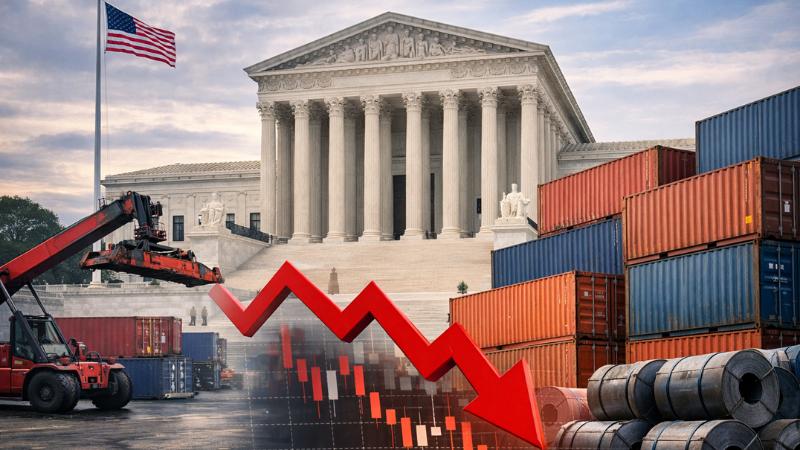
The Supreme Court did not issue a decision Friday on the legality of broad tariffs imposed during President Donald Trump’s administration, extending uncertainty for financial markets and trade policy observers who have been closely watching the case for its potential economic and fiscal implications. Expectations had grown that the ruling might be released before the end of the week, but the court issued only a single opinion on Friday, unrelated to tariffs or trade authority.
The timing of the tariff ruling remains unclear. The Supreme Court is scheduled to release additional decisions on Wednesday, though it is not known whether the tariff case will be among them. When the decision does arrive, it is expected to address whether the administration properly relied on the International Emergency Economic Powers Act to impose the duties and, if that authority is found lacking, whether importers who already paid the tariffs would be entitled to reimbursement.
Legal analysts and market participants say the ruling may not be an all-or-nothing outcome. The court could limit the scope of authority under the emergency powers law while allowing certain tariffs to remain in place, or it could permit the duties to stand while restricting how similar powers are used in the future. Such an outcome would reflect the court’s broad discretion in resolving disputes that carry significant economic and political consequences.
Administration officials have signaled that they are preparing for multiple scenarios. Treasury Secretary Scott Bessent said Thursday that he anticipates a mixed decision that could preserve tariff revenue while constraining executive flexibility. He emphasized that overall tariff collections are likely to continue at similar levels, even if the administration loses some latitude to deploy duties as a tool for national security or trade negotiations.
The tariffs were imposed in part under an emergency declaration aimed at curbing the flow of fentanyl into the United States. A ruling against the administration could complicate those efforts while also affecting broader economic priorities. Economists note that tariffs have played a role in supporting onshoring initiatives and generating federal revenue, but they have also raised costs for importers and consumers.
Market analysts say a loss for the administration would likely prompt alternative strategies to maintain tariffs through other legal authorities. Blocking the existing framework could pressure fiscal conditions and push interest rates higher, while also lowering input costs for companies and potentially boosting corporate earnings. Prediction markets and investor surveys suggest many participants expect the court to rule against the tariffs as currently structured.
Treasury data show that tariffs generated roughly $195 billion in fiscal 2025 and an additional $62 billion in fiscal 2026, raising concerns that large-scale reimbursements could strain efforts to reduce the federal deficit. Despite those risks, the tariff regime has so far produced unexpected results, with limited impact on inflation and a sharp decline in the trade deficit. The imbalance reached its lowest level since 2009, defying fears that tariffs would isolate the United States in global trade.
As markets await clarity, analysts caution that the eventual ruling is likely to reshape trade policy without fully dismantling it, leaving room for adjustment as political and economic priorities evolve.