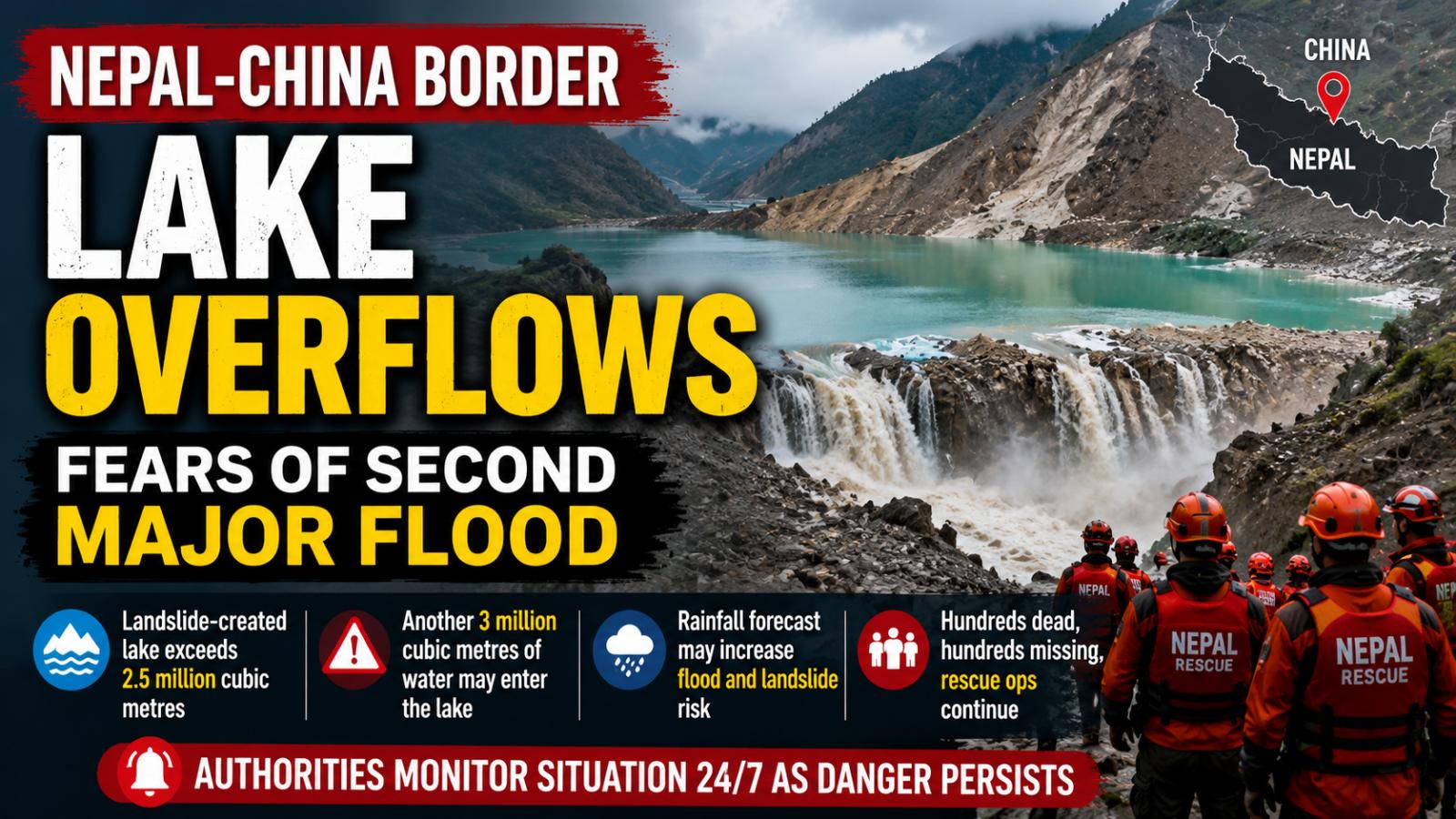
A newly formed lake along the Nepal-China border began overflowing on Friday, raising fears of another major flood only days after a devastating flash flood struck Nepal. Authorities temporarily suspended rescue operations in some high-risk areas as officials assessed the possibility of another surge of water, landslides and avalanches.
The fresh warning comes after Wednesday’s disaster, which killed at least 469 people across Nepal and left hundreds more missing. The earlier flash flood was triggered after a glacier collapse in the Himalayas sent a massive mixture of ice, rock and water downstream, damaging settlements, bridges and hydropower infrastructure.
Nepal-China Border Lake Continues to Rise
Chinese authorities said the landslide-created lake had expanded to more than 2.5 million cubic metres of water, compared with an estimated 1.5 million to 2 million cubic metres a day earlier.
The rising water level forced rescue workers and vehicles on the Chinese side to move to safer locations amid concerns that the temporary natural barrier could fail. Difficult terrain around the lake has also complicated access, with steep and unstable slopes increasing the danger for emergency teams.
Officials have warned that additional water could enter the lake over the coming days, placing greater pressure on the blockage. Forecast rainfall could further increase the risk of flooding and slope failures.
Authorities Fear Another Sudden Flood
Experts are closely monitoring river systems downstream in Nepal, including areas where debris from the earlier disaster may have created temporary obstructions.
Landslide dams can hold large volumes of water before suddenly collapsing. If such a barrier fails, a powerful surge can move downstream with little warning and cause serious damage to already vulnerable communities.
Authorities and disaster-management teams are assessing the stability of the newly formed lake and nearby slopes. Evacuation measures have also been considered for settlements in areas that could be affected by another flood.
Officials remain concerned about further landslides, rockfalls and avalanches because the surrounding mountain terrain remains unstable.
Nepal Rescue Operations Face Fresh Challenge
The renewed flood threat comes as Nepal continues large-scale rescue and recovery operations following the earlier disaster.
Hundreds of people have been reported dead or missing, while rescue teams have been deployed across affected districts. Security personnel, helicopters and ground crews are working to reach isolated communities and search areas covered by mud, debris and floodwater.
Rescue operations have been particularly difficult around damaged hydropower infrastructure, where workers and residents were feared trapped in areas blocked by debris.
The possibility of another flood has added further pressure on emergency teams, forcing authorities to balance ongoing rescue efforts with the safety of personnel working in unstable zones.
Monitoring Continues Around the Clock
Engineering teams are using aerial surveys and other monitoring methods to track changes in the lake and assess the strength of the natural blockage.
For communities downstream, the main concern is whether rising water levels could overwhelm or breach the temporary barrier and send another destructive wave through areas already damaged by flooding.
Authorities are urging residents in vulnerable locations to follow evacuation orders and official safety alerts closely. Emergency agencies are expected to continue monitoring water levels, rainfall and slope stability as the situation develops.