India Hosts Quad Delhi Meeting as Indo-Pacific Security, China and West Asia Tensions Take Centre Stage
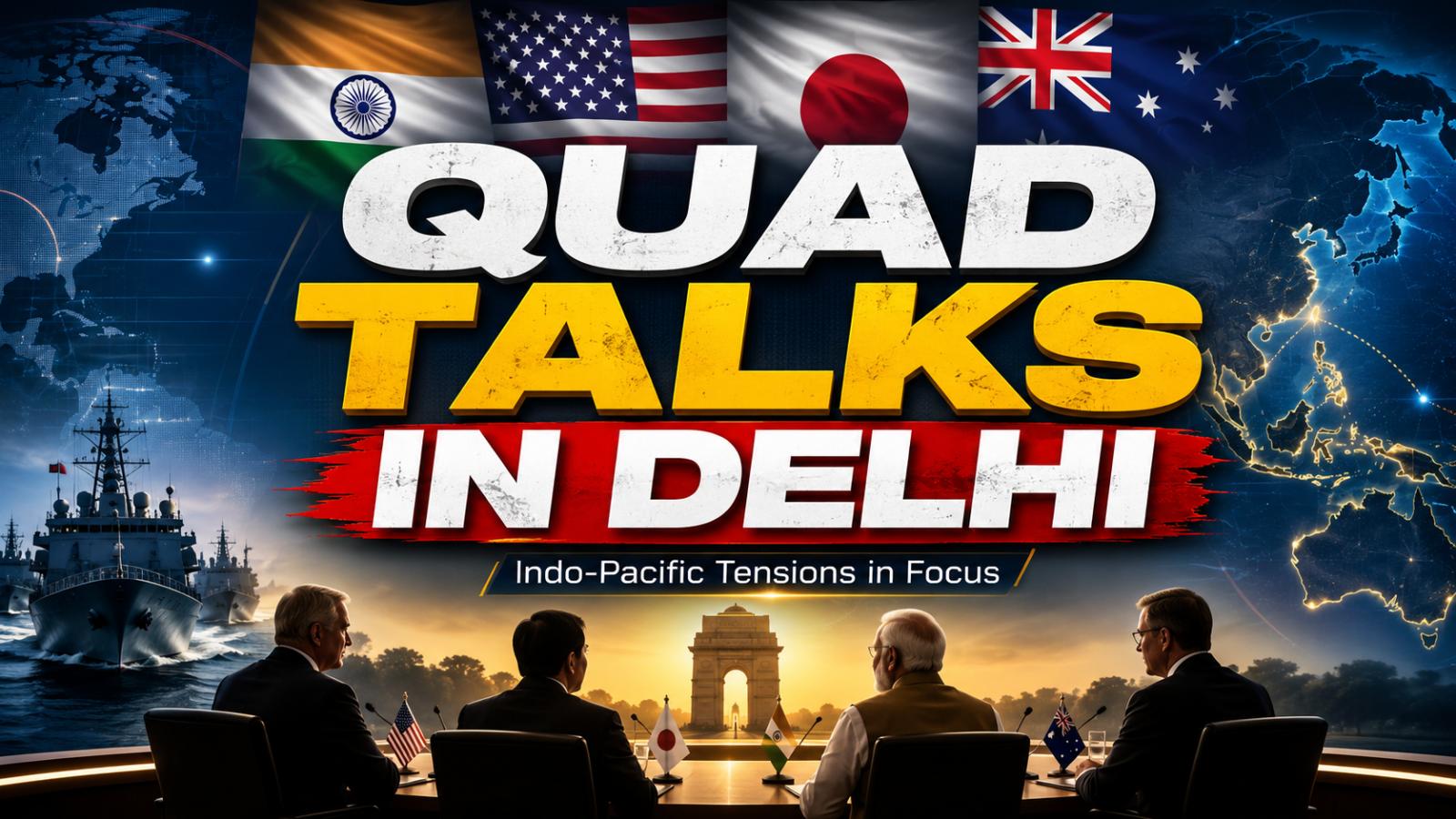
India is hosting the Quad foreign ministers’ meeting in New Delhi on May 26, 2026, bringing together senior leaders from India, the United States, Japan and Australia. External Affairs Minister S. Jaishankar is chairing the meeting, with U.S. Secretary of State Marco Rubio, Australian Foreign Minister Penny Wong and Japanese Foreign Minister Toshimitsu Motegi attending the talks. The participation details are confirmed by India’s Ministry of External Affairs.
The meeting comes at a sensitive moment for the Indo-Pacific region. Rising maritime concerns, China’s growing regional influence, supply chain pressures, energy security risks and uncertainty in West Asia are expected to shape the discussions.
The Quad, officially known as the Quadrilateral Security Dialogue, is a partnership between India, the United States, Japan and Australia. Its broad focus is to support a peaceful, stable, open and resilient Indo-Pacific. Australia’s foreign affairs department describes the Quad as a diplomatic partnership committed to a peaceful, stable and prosperous Indo-Pacific.
Why This Quad Meeting Matters
This meeting is important because the Indo-Pacific is no longer just a regional issue. It is now directly connected to global trade, energy prices, technology security, defence cooperation and the movement of goods across sea routes.
For India, the meeting is also a chance to strengthen its role as a key power in the Indo-Pacific. New Delhi wants to protect its maritime interests, secure supply chains and ensure that no single country dominates critical trade routes.
For the United States, Japan and Australia, India’s position is equally important. India sits close to major shipping lanes and has growing influence in the Indian Ocean region. That makes New Delhi a natural partner in discussions on maritime security and regional balance.
China Concern Remains Central
China is expected to remain one of the main background issues at the Quad meeting. The Quad may not always name China directly in every statement, but many of its priorities are linked to concerns about Beijing’s expanding military, economic and diplomatic reach.
China’s activity in the South China Sea, its influence across Asia, its ties with Pakistan and its broader partnerships with countries such as Russia and Iran are watched closely by Quad members.
For India, the China-Pakistan connection is especially sensitive. For Japan and Australia, maritime pressure and regional influence are major concerns. For the United States, the Indo-Pacific remains central to its long-term competition with China.
The real test will be the final statement. If the language is cautious, it may show that the Quad wants to avoid direct escalation. If the wording is sharper, it may signal a stronger collective position on regional security.
Maritime Security and Safe Trade Routes
Maritime security is likely to be one of the strongest themes of the Delhi meeting. This includes maritime domain awareness, safe sea routes, port security, illegal fishing, undersea cables and protection of trade routes.
These issues may sound diplomatic, but they affect ordinary people too. When sea routes are unsafe, shipping costs rise. When shipping costs rise, businesses pay more. When businesses pay more, consumers eventually feel the impact through higher prices.
For India and other Quad countries, secure sea lanes are essential for energy, food, technology goods, medicines and industrial supplies.
West Asia Tensions and Strait of Hormuz Risk
Tensions in West Asia are also expected to influence the discussions. Any instability around Iran and the Strait of Hormuz can create serious risks for global energy shipments.
The Strait of Hormuz is one of the world’s most important energy transit routes. If movement through this route is disrupted, oil prices and shipping insurance costs can rise quickly. Countries such as India, Japan and Australia have strong reasons to watch this closely because energy security is directly linked to economic stability.
The Quad is not a military alliance, but it does discuss security challenges that affect the wider Indo-Pacific and global economy. That is why West Asia tensions may become part of the larger conversation on maritime safety and supply chain protection.
Supply Chains and Critical Minerals
The Delhi meeting is also expected to discuss supply chain resilience and critical minerals. This is a major area where the Quad can move beyond statements and create practical cooperation.
Critical minerals are needed for electric vehicles, batteries, semiconductors, defence systems, clean energy and advanced electronics. Countries do not want to depend too heavily on one supplier or one region for these materials.
For India, this is an opportunity to attract investment, build processing capacity and become a stronger part of global technology supply chains. For the United States, Japan and Australia, cooperation with India can help reduce supply risks and create trusted alternatives.
Cybersecurity, Infrastructure and Technology
Cybersecurity is another important part of the Quad agenda. As governments, banks, businesses, hospitals and public services become more digital, cyber threats are becoming a national security issue.
The Quad countries are likely to discuss cooperation in secure technology, digital infrastructure, cyber resilience and protection of critical systems. Infrastructure and connectivity may also be discussed, especially projects that offer transparent and reliable alternatives to debt-heavy models.
This is where the Quad can become more useful for smaller countries in the Indo-Pacific. If the group can support better ports, digital systems, health networks and disaster response, it can build trust beyond military and diplomatic circles.
Jaishankar-Rubio Talks Add Bilateral Weight
The meeting also comes with strong India-U.S. attention. Jaishankar and Rubio held bilateral discussions in New Delhi ahead of the Quad meeting, reviewing strategic cooperation between India and the United States. Reports said the talks covered areas such as energy, defence, trade and critical minerals.
This matters because the Quad’s strength depends heavily on how well the four countries manage their individual relationships. If India and the United States remain aligned on major security and economic issues, the Quad gains more weight.
At the same time, India will continue to protect its strategic independence. New Delhi wants strong partnerships, but it does not want to be seen as simply following another country’s foreign policy.
Roadmap for the Next Quad Leaders’ Summit
The foreign ministers’ meeting is expected to prepare the ground for the next Quad Leaders’ Summit. The roadmap may include maritime security, critical minerals, clean energy, health security, humanitarian assistance, disaster response, infrastructure, cyber cooperation and counter-terrorism.
The final joint statement will be important. It will show whether the Quad is focused mainly on practical cooperation or whether it is ready to send a stronger geopolitical message.
What to Watch Next
The biggest thing to watch is the language used after the meeting. If the statement strongly mentions maritime security, coercion, supply chain risks or freedom of navigation, it will be read as a signal toward China.
If the statement focuses more on development, technology, health and infrastructure, it may show that the Quad wants to keep the tone balanced.
Either way, the Delhi meeting gives India a major diplomatic stage. At a time when the Indo-Pacific, China tensions and West Asia instability are all connected, the Quad’s message from New Delhi will be watched closely by governments, businesses and strategic experts across the world.