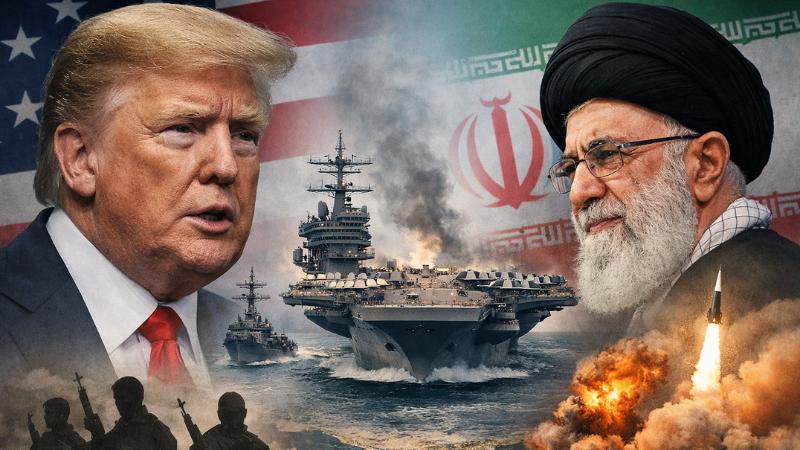
Uncertainty continues to surround Washington’s approach toward Tehran as President Donald Trump sends conflicting signals on whether the United States is moving closer to military action or renewed diplomacy with Iran. Speaking ahead of his first Cabinet meeting of 2026, the president indicated he was open to communication with Iranian leaders, even as the US expanded its military presence in West Asia and senior defense officials stressed readiness to act on presidential orders.
According to officials familiar with internal deliberations, the administration has reviewed an expanded set of military options aimed at Iran’s nuclear and missile infrastructure, as well as measures designed to weaken the authority of Supreme Leader Ayatollah Ali Khamenei. These options reportedly range from limited strikes to more complex operations targeting sensitive facilities. The review reflects growing concern within Washington over Iran’s nuclear trajectory and its regional influence.
The mixed messaging has added to uncertainty in a region already under strain. Earlier this month, the administration warned Tehran against the violent suppression of domestic protests, raising the prospect of consequences if demonstrators were harmed. Those warnings were later followed by a pause in overt military threats after Iranian authorities signaled restraint on internal security measures and regional partners urged caution.
In recent days, however, the tone has shifted again. The US has deployed additional naval assets to the region, a move widely interpreted as a signal of deterrence. The president publicly described the deployment as a powerful force capable of swift action, while simultaneously expressing hope that Iran would agree to negotiations aimed at preventing the development of nuclear weapons. Despite this, no details have been offered about potential talks, including timing or representation, leaving observers uncertain about Washington’s next steps.
Defense officials have underscored that military preparedness remains high. Senior leaders have reiterated that Iran must not acquire nuclear capabilities and that US forces are positioned to respond rapidly if ordered. The presence of tens of thousands of American troops across multiple regional bases underscores both the stakes involved and the risks of escalation.
From Tehran’s perspective, a potential US strike would present difficult choices. Iran has spent decades preparing for confrontation with Washington and has invested heavily in asymmetric capabilities designed to offset American military superiority. Analysts say Iran could respond through a combination of missile and drone attacks, actions against US bases or allies, and indirect operations carried out by aligned groups across the region.
Iran possesses a large inventory of short- and medium-range missiles and unmanned aerial systems, which are believed to be capable of reaching US installations and allied targets. Past confrontations have demonstrated Tehran’s willingness to use these tools in coordinated waves, challenging even advanced air defense systems. US officials have acknowledged that American forces in the region are within range of such weapons, adding to concerns over troop safety.
Another potential response would involve targeting regional allies of the United States or critical infrastructure viewed as supporting any attack. Iranian leaders have warned that retaliation would be swift and far-reaching, framing any US military action as the start of a broader conflict. Such rhetoric has heightened fears of a regional escalation that could draw in multiple actors.
Iran’s network of allied groups also remains a key factor. While some of these organizations have been weakened by recent conflicts, they retain the capacity to conduct attacks that could widen the crisis. Calls from militia leaders for readiness underscore the risk that a localized confrontation could quickly spread beyond bilateral tensions.
Economic retaliation is another option under consideration. The Strait of Hormuz, a narrow but vital shipping lane, carries a significant share of the world’s oil and liquefied natural gas exports. Any disruption to traffic through the strait, whether through mining or other actions, would likely send shockwaves through global energy markets and impact economies far beyond the region.
Diplomacy, while still theoretically possible, faces deep mistrust. Iranian officials remain wary after past agreements unraveled and recent diplomatic efforts failed to produce results. Tehran has signaled resistance to demands that would limit its missile program, halt domestic nuclear enrichment, or end support for regional allies, viewing these issues as core to its security and political identity.
As tensions rise, analysts warn that every available option carries significant risks for both sides. Concessions could be seen domestically in Iran as a sign of weakness, while military confrontation could trigger consequences that are difficult to contain. For now, the situation remains finely balanced, with the region watching closely to see whether Washington’s next move will favor dialogue or force.