Texas is considering a Texas REAL ID rule change that could make it harder for some lawful temporary visa holders to obtain a driver’s license or state identification card.
The proposal from the Texas Department of Public Safety would require a foreign passport submitted with a REAL ID application to contain a valid U.S. visa. Public comments are open through Sunday, July 26, 2026.
How the Texas REAL ID Rule Change Would Work
Current Texas ru
Texas is considering a Texas REAL ID rule change that could make it harder for some lawful temporary visa holders to obtain a driver’s license or state identification card.
The proposal from the Texas Department of Public Safety would require a foreign passport submitted with a REAL ID application to contain a valid U.S. visa. Public comments are open through Sunday, July 26, 2026.
How the Texas REAL ID Rule Change Would Work
Current Texas ru
Region under severe strain after twin quakes
La Guaira is facing mounting pressure after successive earthquakes caused widespread disruption across coastal communities. Entire neighborhoods have been damaged, leaving thousands without stable housing. Emergency services are stretched thin as access roads remain partially blocked and essential infrastructure continues
Region under severe strain after twin quakes
La Guaira is facing mounting pressure after successive earthquakes caused widespread disruption across coastal communities. Entire neighborhoods have been damaged, leaving thousands without stable housing. Emergency services are stretched thin as access roads remain partially blocked and essential infrastructure continues
India considers expiry safeguard in US trade talks
India is reportedly preparing to seek a sunset clause in its proposed interim trade agreement with the United States, reflecting a growing global trend among trading partners to build expiry mechanisms into major economic deals. The move aligns closely with recent developments in European Union–US trade arrangements, where similar provisions have been introduced to limit long-term exposure
India considers expiry safeguard in US trade talks
India is reportedly preparing to seek a sunset clause in its proposed interim trade agreement with the United States, reflecting a growing global trend among trading partners to build expiry mechanisms into major economic deals. The move aligns closely with recent developments in European Union–US trade arrangements, where similar provisions have been introduced to limit long-term exposure
LONDON — Jannik Sinner survived a five-set Wimbledon scare on Monday, June 29, 2026, defeating Miomir Kecmanovic 4-6, 6-3, 6-7 (6), 6-2, 6-3 in the first round on Centre Court.
The defending champion twice recovered from a one-set deficit and overcame a fall during the 3-hour, 30-minute match. The victory sent the world No. 1 into the second round and kept his Wimbledon title defense alive.
How Jannik Sinner survived his Wimbledon opener
Kecm
LONDON — Jannik Sinner survived a five-set Wimbledon scare on Monday, June 29, 2026, defeating Miomir Kecmanovic 4-6, 6-3, 6-7 (6), 6-2, 6-3 in the first round on Centre Court.
The defending champion twice recovered from a one-set deficit and overcame a fall during the 3-hour, 30-minute match. The victory sent the world No. 1 into the second round and kept his Wimbledon title defense alive.
How Jannik Sinner survived his Wimbledon opener
Kecm
India has sent humanitarian assistance to Venezuela after two powerful earthquakes struck west of Caracas on Wednesday, June 24, 2026. The response, called Operation Amistad, adds to a broader record of Indian disaster relief, medical support and emergency supplies delivered overseas.
Under the mission, two Indian Air Force C-17 transport aircraft carried an Indian Army field hospital, two BHISHM emergency medical units, medicines, medical equipment and more than 35 tonnes of relief
India has sent humanitarian assistance to Venezuela after two powerful earthquakes struck west of Caracas on Wednesday, June 24, 2026. The response, called Operation Amistad, adds to a broader record of Indian disaster relief, medical support and emergency supplies delivered overseas.
Under the mission, two Indian Air Force C-17 transport aircraft carried an Indian Army field hospital, two BHISHM emergency medical units, medicines, medical equipment and more than 35 tonnes of relief
Meta is facing renewed criticism after conservation groups raised concerns that illegal wildlife trade continues to appear across its platforms despite company rules against such activity. The report claims Facebook, Instagram and WhatsApp are being used by traffickers and sellers to promote endangered animals, wild meat and banned wildlife products to online buyers.
The findings have put fresh attention on how social media platforms handl
Meta is facing renewed criticism after conservation groups raised concerns that illegal wildlife trade continues to appear across its platforms despite company rules against such activity. The report claims Facebook, Instagram and WhatsApp are being used by traffickers and sellers to promote endangered animals, wild meat and banned wildlife products to online buyers.
The findings have put fresh attention on how social media platforms handl
Rolls-Royce and India discussed deeper manufacturing investment, technology partnerships and an engine proposal tied to the country’s next-generation AMCA fighter program on Friday, June 26, 2026.
The talks focused on how the India-UK Comprehensive Economic and Trade Agreement, or CETA, could support advanced manufacturing, engineering cooperation and more resilient supply chains.
Rolls-Royce India Manufacturing Investment
Rolls-Royce and India discussed deeper manufacturing investment, technology partnerships and an engine proposal tied to the country’s next-generation AMCA fighter program on Friday, June 26, 2026.
The talks focused on how the India-UK Comprehensive Economic and Trade Agreement, or CETA, could support advanced manufacturing, engineering cooperation and more resilient supply chains.
Rolls-Royce India Manufacturing Investment
BEIJING — A small aircraft reportedly crashed into CITIC Tower in Beijing’s central business district at about 6:00 p.m. China Standard Time on Friday, June 26, 2026. The Beijing plane crash damaged part of the tower’s glass facade and sent debris toward streets below.
The 108-story building, widely known as China Zun, stands 528 meters, or 1,732 feet, tall and is Beijing’s tallest skyscraper.
Beijing Plane Crash Prompts Evacuation
A fi
BEIJING — A small aircraft reportedly crashed into CITIC Tower in Beijing’s central business district at about 6:00 p.m. China Standard Time on Friday, June 26, 2026. The Beijing plane crash damaged part of the tower’s glass facade and sent debris toward streets below.
The 108-story building, widely known as China Zun, stands 528 meters, or 1,732 feet, tall and is Beijing’s tallest skyscraper.
Beijing Plane Crash Prompts Evacuation
A fi
A video circulating online featuring former Russian volunteer commander Alexander Lunin has triggered discussion about possible internal strain within sections of Russia’s military. In the recording, he suggests that prolonged combat operations in Ukraine have created growing frustration among some soldiers, though no independent verification supports claims of organized unrest.
The remarks have drawn attention because public criticism linke
A video circulating online featuring former Russian volunteer commander Alexander Lunin has triggered discussion about possible internal strain within sections of Russia’s military. In the recording, he suggests that prolonged combat operations in Ukraine have created growing frustration among some soldiers, though no independent verification supports claims of organized unrest.
The remarks have drawn attention because public criticism linke
The B-52 Stratofortress relies on a drag chute to help slow the aircraft immediately after touchdown. Instead of depending only on wheel brakes, the system deploys a parachute from the rear of the aircraft that creates strong air resistance. This resistance reduces speed quickly and stabilizes the landing rollout, especially important for such a large and heavy bomber.
Why the aircraft needs extra braking support
A fully loaded B-52 carries enormous mass and lands at high speeds, which naturally generates extreme heat and stress on its wheel braking system. If only standard brakes were used, stopping distance would increase significantly and brake components could overheat or wear out rapidly. The drag chute reduces this burden by absorbing a portion of the kinetic energy during rollout.
How the system is activated during landing
Once the aircraft touches down and is stable on the runway, the crew initiates the drag chute deployment. A small pilot chute is released first, which pulls out the main parachute from its housing in the tail section. As it inflates, it creates immediate drag force that slows the aircraft even before full brake pressure is applied on the wheels.
Impact on runway distance and safety
The chute significantly shortens the distance required to bring the bomber to a safe stop. This becomes especially valuable on wet, icy, or short runways where braking efficiency is reduced. By lowering reliance on friction-based braking alone, the system improves safety margins and allows more flexible landing operations in different environments.
Operational use in real conditions
In practice, crews often rely on the drag chute as a standard part of landing procedures because it protects the braking system and enhances control. It is particularly important during adverse weather conditions or high-weight landings. Ground teams then recover and repack the chute after use for the next mission.
A system built for rapid nuclear response...
Why the system is still relevant today
Despite being designed decades ago, the drag chute remains an effective and simple solution to a complex problem: stopping a very heavy aircraft safely in limited runway space. Its continued use highlights how practical engineering solutions can stay valuable long after the aircraft itself enters modern service cycles.
The B-52 Stratofortress relies on a drag chute to help slow the aircraft immediately after touchdown. Instead of depending only on wheel brakes, the system deploys a parachute from the rear of the aircraft that creates strong air resistance. This resistance reduces speed quickly and stabilizes the landing rollout, especially important for such a large and heavy bomber.
Why the aircraft needs extra braking support
A fully loaded B-52 carries enormous mass and lands at high speeds, which naturally generates extreme heat and stress on its wheel braking system. If only standard brakes were used, stopping distance would increase significantly and brake components could overheat or wear out rapidly. The drag chute reduces this burden by absorbing a portion of the kinetic energy during rollout.
How the system is activated during landing
Once the aircraft touches down and is stable on the runway, the crew initiates the drag chute deployment. A small pilot chute is released first, which pulls out the main parachute from its housing in the tail section. As it inflates, it creates immediate drag force that slows the aircraft even before full brake pressure is applied on the wheels.
Impact on runway distance and safety
The chute significantly shortens the distance required to bring the bomber to a safe stop. This becomes especially valuable on wet, icy, or short runways where braking efficiency is reduced. By lowering reliance on friction-based braking alone, the system improves safety margins and allows more flexible landing operations in different environments.
Operational use in real conditions
In practice, crews often rely on the drag chute as a standard part of landing procedures because it protects the braking system and enhances control. It is particularly important during adverse weather conditions or high-weight landings. Ground teams then recover and repack the chute after use for the next mission.
A system built for rapid nuclear response...
Why the system is still relevant today
Despite being designed decades ago, the drag chute remains an effective and simple solution to a complex problem: stopping a very heavy aircraft safely in limited runway space. Its continued use highlights how practical engineering solutions can stay valuable long after the aircraft itself enters modern service cycles.
Confusion over alleged discussions involving Iran’s missile capabilities in US–Iran diplomatic engagement was addressed by Pakistan after multiple conflicting interpretations surfaced from international officials. Prime Minister Shehbaz Sharif clarified that no such subject was included in any current structured understanding between Washington and Tehran, pushing back against circulating claims that had gained attention in diplomatic circles.
Confusion over alleged discussions involving Iran’s missile capabilities in US–Iran diplomatic engagement was addressed by Pakistan after multiple conflicting interpretations surfaced from international officials. Prime Minister Shehbaz Sharif clarified that no such subject was included in any current structured understanding between Washington and Tehran, pushing back against circulating claims that had gained attention in diplomatic circles.
The United States is stepping up its focus on quantum computing as governments and private companies race to control the next major shift in computing power. The strategy combines research funding, national security planning, and stronger digital defense systems designed to prepare for future computational threats.
Rather than treating quantum computing as a distant research topic, policymakers are now positioning it as a strategic infrastructure priority. The direction signals a broader effort to maintain technological leadership in areas where classical computing is approaching its limits.
Big tech and government alignment
Federal agencies are increasingly coordinating with major technology companies including IBM, Microsoft, and Google, all of which are actively building experimental quantum systems. These companies are exploring how quantum processors could eventually solve complex optimization, material science, and cryptography-related problems that are currently impractical for classical machines.
The collaboration is not just scientific. It reflects a competitive global environment where control over advanced computing could influence national security, economic strength, and cybersecurity resilience.
Why qubits change the computing model
Unlike traditional computers that process data in binary form, quantum systems rely on qubits. These units can exist in multiple states simultaneously, enabling different types of computation through principles such as superposition and entanglement.
In theory, this allows quantum systems to evaluate a vast number of possibilities at once. However, real-world systems remain extremely fragile, expensive, and difficult to scale. Most current machines operate in controlled laboratory environments rather than practical deployment settings.
Cybersecurity pressure is rising
One of the biggest drivers behind quantum investment is its impact on encryption. Modern security systems depend on mathematical problems that are extremely difficult for classical computers to solve. Quantum algorithms, in the long term, could potentially break some of these systems.
This risk is pushing governments toward post-quantum cryptography standards developed by research bodies such as NIST. These new encryption models are designed to remain secure even against quantum-level computational attacks.
Long road to practical systems
Despite rapid progress, fully functional large-scale quantum computers are still years away. Challenges include error correction, stability, and hardware scaling. Researchers agree that meaningful commercial use is still in early stages.
Even so, the strategic push continues because early leadership in quantum infrastructure could determine future advantages in defense, intelligence, and advanced science applications.
The current phase is less about immediate transformation and more about positioning for a technological shift that could redefine computing over the next decade.
The United States is stepping up its focus on quantum computing as governments and private companies race to control the next major shift in computing power. The strategy combines research funding, national security planning, and stronger digital defense systems designed to prepare for future computational threats.
Rather than treating quantum computing as a distant research topic, policymakers are now positioning it as a strategic infrastructure priority. The direction signals a broader effort to maintain technological leadership in areas where classical computing is approaching its limits.
Big tech and government alignment
Federal agencies are increasingly coordinating with major technology companies including IBM, Microsoft, and Google, all of which are actively building experimental quantum systems. These companies are exploring how quantum processors could eventually solve complex optimization, material science, and cryptography-related problems that are currently impractical for classical machines.
The collaboration is not just scientific. It reflects a competitive global environment where control over advanced computing could influence national security, economic strength, and cybersecurity resilience.
Why qubits change the computing model
Unlike traditional computers that process data in binary form, quantum systems rely on qubits. These units can exist in multiple states simultaneously, enabling different types of computation through principles such as superposition and entanglement.
In theory, this allows quantum systems to evaluate a vast number of possibilities at once. However, real-world systems remain extremely fragile, expensive, and difficult to scale. Most current machines operate in controlled laboratory environments rather than practical deployment settings.
Cybersecurity pressure is rising
One of the biggest drivers behind quantum investment is its impact on encryption. Modern security systems depend on mathematical problems that are extremely difficult for classical computers to solve. Quantum algorithms, in the long term, could potentially break some of these systems.
This risk is pushing governments toward post-quantum cryptography standards developed by research bodies such as NIST. These new encryption models are designed to remain secure even against quantum-level computational attacks.
Long road to practical systems
Despite rapid progress, fully functional large-scale quantum computers are still years away. Challenges include error correction, stability, and hardware scaling. Researchers agree that meaningful commercial use is still in early stages.
Even so, the strategic push continues because early leadership in quantum infrastructure could determine future advantages in defense, intelligence, and advanced science applications.
The current phase is less about immediate transformation and more about positioning for a technological shift that could redefine computing over the next decade.
The Justice Department and Department of Education have entered an agreement to strengthen FERPA and PPRA enforcement in schools, focusing on parents’ access to education records, student privacy complaints and consent for certain surveys.
Assistant Attorney General Harmeet Dhillon announced the initiative in a video posted on X on Wednesday, June 17, 2026. The agreement itself is dated Monday, June 15, 2026.
FERPA and PPRA enforcement focuses o
The Justice Department and Department of Education have entered an agreement to strengthen FERPA and PPRA enforcement in schools, focusing on parents’ access to education records, student privacy complaints and consent for certain surveys.
Assistant Attorney General Harmeet Dhillon announced the initiative in a video posted on X on Wednesday, June 17, 2026. The agreement itself is dated Monday, June 15, 2026.
FERPA and PPRA enforcement focuses o
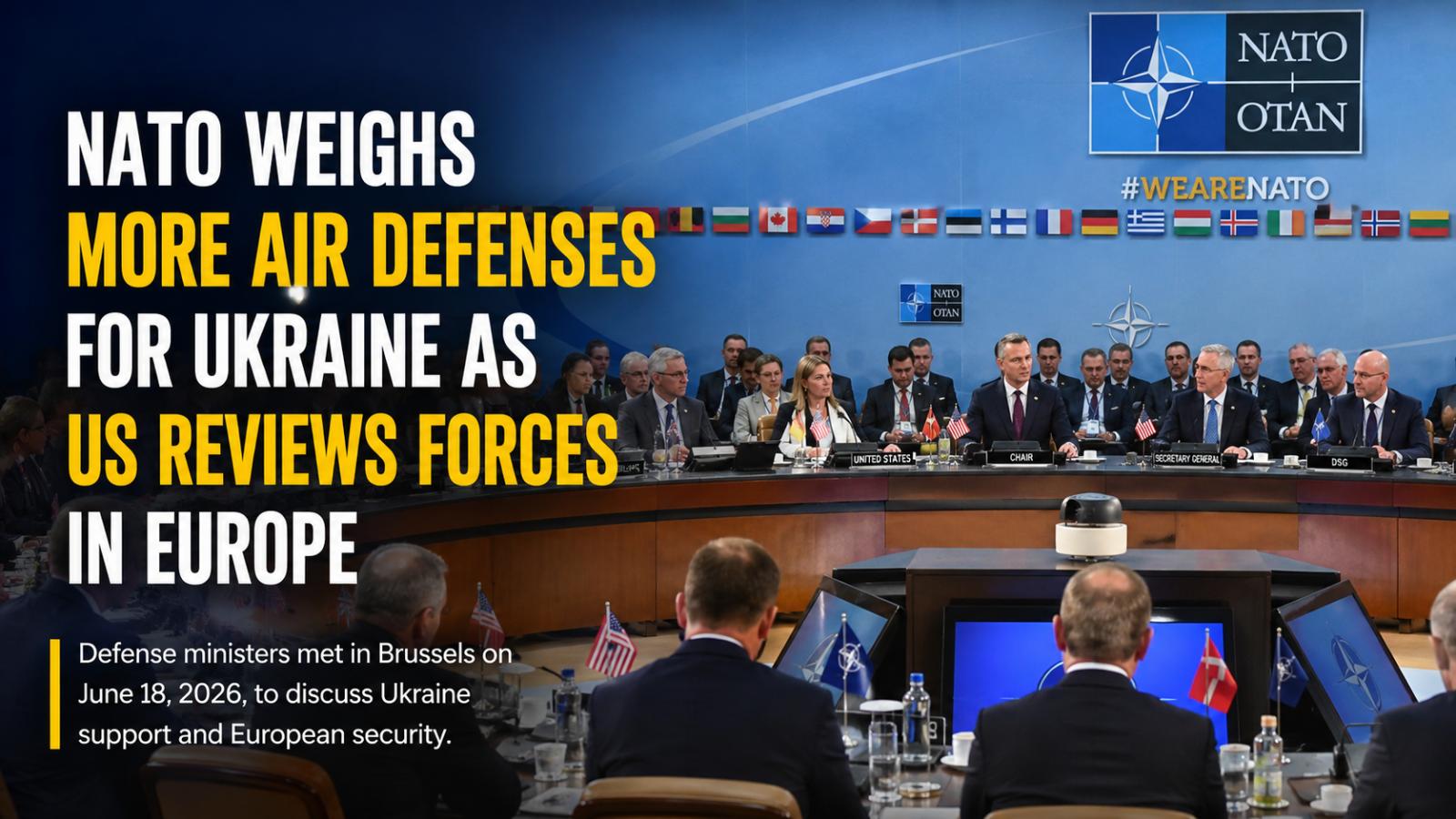
BRUSSELS — A US troop review in Europe is reshaping NATO discussions over Ukraine’s air defenses and the alliance’s long-term security responsibilities.
Defense ministers meeting in Brussels on Thursday, June 18, 2026, considered additional weapons, missile interceptors and air-defense support for Ukraine as Washington began reassessing the scale and structure of American military deployments across Europe.
US Troop Review in Europe Puts Pressure on NATO All
BRUSSELS — A US troop review in Europe is reshaping NATO discussions over Ukraine’s air defenses and the alliance’s long-term security responsibilities.
Defense ministers meeting in Brussels on Thursday, June 18, 2026, considered additional weapons, missile interceptors and air-defense support for Ukraine as Washington began reassessing the scale and structure of American military deployments across Europe.
US Troop Review in Europe Puts Pressure on NATO All
A Moscow oil refinery drone attack damaged a fuel facility, injured at least 17 people and temporarily disrupted flights at airports serving the Russian capital. Ukrainian forces carried out what the report described as their largest drone offensive against Moscow since the full-scale war began.
Moscow oil refinery drone attack hits Kapotnya
The Moscow Oil Refinery in Kapotnya, about 9 miles southeast of the Kremlin, was among the main sites affected. Vi
A Moscow oil refinery drone attack damaged a fuel facility, injured at least 17 people and temporarily disrupted flights at airports serving the Russian capital. Ukrainian forces carried out what the report described as their largest drone offensive against Moscow since the full-scale war began.
Moscow oil refinery drone attack hits Kapotnya
The Moscow Oil Refinery in Kapotnya, about 9 miles southeast of the Kremlin, was among the main sites affected. Vi
Taiwan has renewed its push for approval of a proposed $14 billion defense package from the United States, arguing that its security environment has become increasingly unstable. The request comes at a time when military activity and political messaging across the Taiwan Strait have intensified, placing additional pressure on Washington’s strategic decision-making.
US officials are currently evaluating the proposal through standard defense export channels, weighing supply constrai
Taiwan has renewed its push for approval of a proposed $14 billion defense package from the United States, arguing that its security environment has become increasingly unstable. The request comes at a time when military activity and political messaging across the Taiwan Strait have intensified, placing additional pressure on Washington’s strategic decision-making.
US officials are currently evaluating the proposal through standard defense export channels, weighing supply constrai
The Laredo private jet crash on Loop 20 killed one person after a Cessna Citation Latitude carrying six people came down near Laredo International Airport and erupted in flames shortly after 10 p.m. local time.
Officials had not determined whether the person who died was aboard the aircraft or on the ground. No injuries on the ground were immediately reported.
Laredo private jet crash prompts roadside rescue
Drivers found the a
The Laredo private jet crash on Loop 20 killed one person after a Cessna Citation Latitude carrying six people came down near Laredo International Airport and erupted in flames shortly after 10 p.m. local time.
Officials had not determined whether the person who died was aboard the aircraft or on the ground. No injuries on the ground were immediately reported.
Laredo private jet crash prompts roadside rescue
Drivers found the a
U.S. President Donald Trump called Indian Prime Minister Narendra Modi a “tough negotiator” following their meeting at the 2026 G7 summit in Évian-les-Bains, France.
The Trump-Modi G7 meeting on Wednesday, June 17, 2026, focused on U.S.-India trade negotiations, bilateral relations and the safety of Indian seafarers operating near the Strait of Hormuz.
Trump-Modi G7 Meeting Focuses on Trade
Speaking to reporters after the bilateral discuss
U.S. President Donald Trump called Indian Prime Minister Narendra Modi a “tough negotiator” following their meeting at the 2026 G7 summit in Évian-les-Bains, France.
The Trump-Modi G7 meeting on Wednesday, June 17, 2026, focused on U.S.-India trade negotiations, bilateral relations and the safety of Indian seafarers operating near the Strait of Hormuz.
Trump-Modi G7 Meeting Focuses on Trade
Speaking to reporters after the bilateral discuss
US Restores Pacific Command Name in Symbolic Military Rebranding
The United States Department of War has officially renamed its largest military command, reverting the Indo-Pacific Command back to its original designation, US Pacific Command. The announcement was made on Tuesday, June 16,2026 with officials confirming that the change is symbolic and will not alter operational responsibilities, deployment st
US Restores Pacific Command Name in Symbolic Military Rebranding
The United States Department of War has officially renamed its largest military command, reverting the Indo-Pacific Command back to its original designation, US Pacific Command. The announcement was made on Tuesday, June 16,2026 with officials confirming that the change is symbolic and will not alter operational responsibilities, deployment st
Bullet Ant Ritual of the Amazon
Deep in the Amazon rainforest, the Sateré-Mawé people practice one of the most intense coming-of-age rituals known to anthropology. The ceremony centers around the bullet ant, an insect whose sting is widely considered among the most painful in the world. For the community, however, the ritual is not about pain alone but about discipline, courage, and readiness for adulthoo
Bullet Ant Ritual of the Amazon
Deep in the Amazon rainforest, the Sateré-Mawé people practice one of the most intense coming-of-age rituals known to anthropology. The ceremony centers around the bullet ant, an insect whose sting is widely considered among the most painful in the world. For the community, however, the ritual is not about pain alone but about discipline, courage, and readiness for adulthoo