Edit

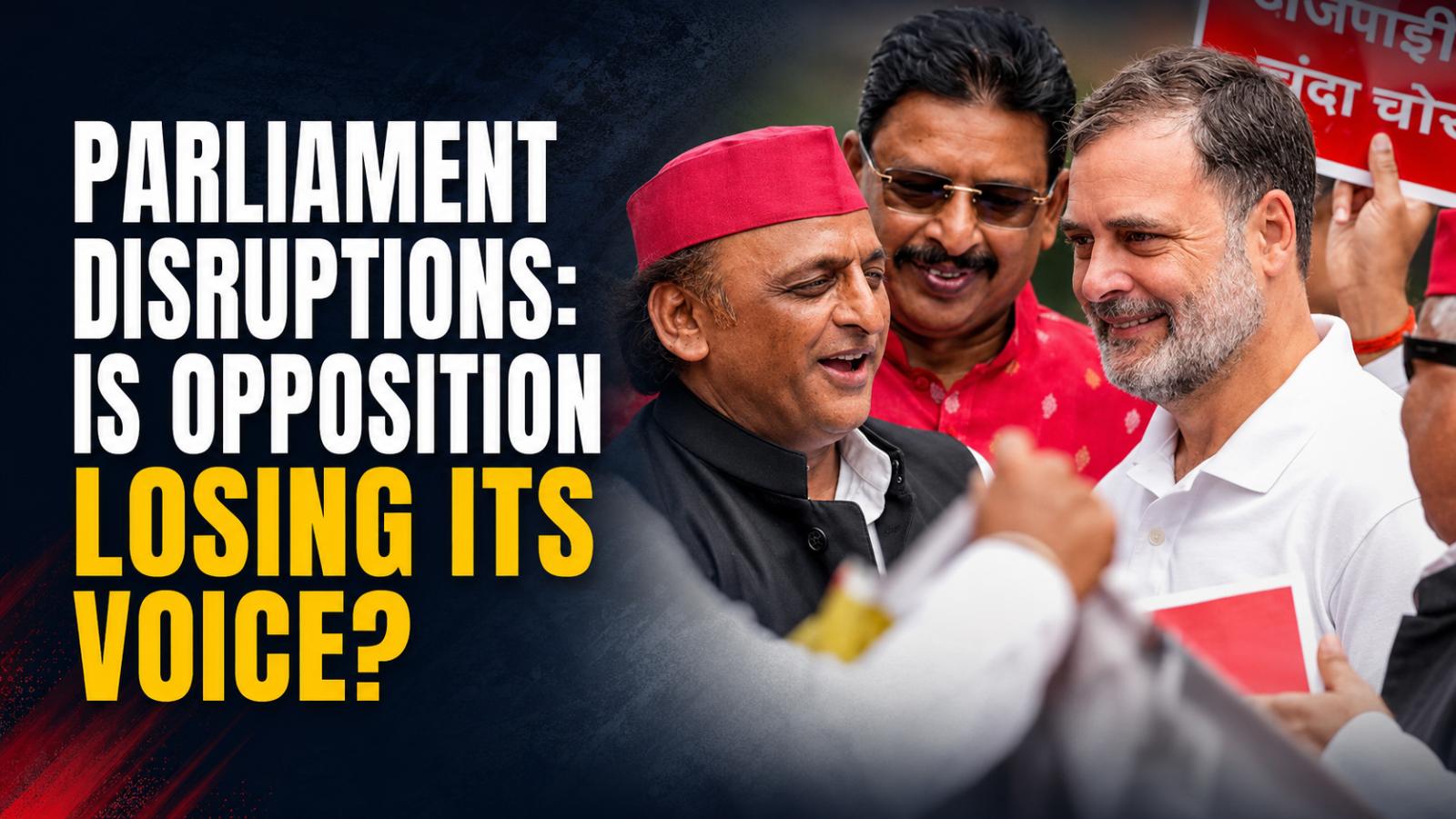
Parliament disruptions in India: Is Opposition losing its voice?

Parliament disruptions in India: Is Opposition losing its voice?
Parliament disruptions in India have repeatedly interrupted the Monsoon Session. While protests can spotlight important issues, they also weaken Question Hour accountability and parliamentary bill scrutiny, leaving Opposition MPs with fewer opportunities to challenge the government.

 

Question Hour accountability lost amid repeated protests

Repeated protests and adjournments during the Monsoon Session have raised a difficult question for Opposition parties: Are they weakening the very platform they need to challenge the government?

Disruptions can put pressure on the ruling party and draw public attention to issues that might otherwise receive limited coverage. However, when Parliament remains stalled for long periods, Opposition MPs lose valuable opportunities to question ministers, examine government decisions and place their concerns on the official record.

Congress MP Shashi Tharoor raised this concern while speaking at an event organised by India’s International Movement to Unite Nations. He said demonstrations, slogans, sit-ins and other forms of protest have a legitimate place in a democracy. Parliament, however, has a different purpose. It is where political disagreement must be converted into questions, evidence, arguments and reasoned debate.

Question Hour is one of the Opposition’s strongest accountability tools. MPs can ask ministers for information about government policies, programmes, expenditure and administrative decisions. Starred questions allow supplementary queries, enabling members to challenge incomplete answers or seek immediate clarification.

Zero Hour provides another opportunity to raise urgent matters of public importance, subject to the Speaker’s permission. Rule 377 also enables Lok Sabha members to place constituency concerns and broader public-interest issues before the House.

These procedures matter more to the Opposition because ruling-party MPs generally have better access to ministers and the executive. Opposition members depend heavily on Parliament to demand public answers. Every adjournment therefore takes away time that could have been used to question the government.

Opposition parties often disrupt proceedings when they believe the government is refusing to discuss an important subject. This strategy can generate headlines and force a political response. But attention outside Parliament cannot fully replace accountability inside it.

Parliamentary bill scrutiny matters beyond the final vote

The cost of disruption becomes more serious when bills are passed without meaningful discussion. According to the Lok Sabha proceedings cited during the Monsoon Session, the Tribunals Reforms Bill, 2026 was passed on August 10 amid Opposition protests and without a full debate.

The government may face criticism for moving legislation without adequate discussion, but it still retains its numerical majority. The Opposition loses the opportunity to question individual provisions, propose amendments and explain its objections to the public.

Parliament is not merely a voting chamber. A bill’s passage is only one part of the legislative process. Debate allows MPs to examine its purpose, identify unintended consequences and require ministers to defend the government’s position. Parliamentary committees can provide deeper scrutiny by studying evidence, consulting stakeholders and recommending changes.

Even when the government rejects Opposition arguments, those objections become part of the legislative record. That record helps citizens, researchers and legal experts understand the circumstances in which a law was enacted. A brief statement of objectives cannot provide the same depth as a genuine exchange between the government and the Opposition.

Tharoor’s argument challenges the assumption that debate is pointless when the government already has the votes. The Opposition may not be able to defeat every bill, but it can expose weaknesses, influence public opinion and force ministers to answer difficult questions.

Opposition leaders, including Rahul Gandhi, have alleged that their microphones were switched off during proceedings. The government and parliamentary authorities have rejected or disputed these allegations. Such competing claims make orderly proceedings more important, as a functioning House gives both sides an official forum to present their positions.

Protest remains a legitimate democratic instrument, particularly when Opposition parties believe that important issues are being ignored. But disruption should be a limited tactic rather than the default strategy. If Parliament cannot function, the government may continue using its majority while the Opposition gives up its strongest tools of scrutiny.

The government may have the votes, but the Opposition needs Parliament to test those votes through evidence, questions and debate. Without that engagement, it risks attracting momentary attention while losing lasting political influence.

What is your response?

joyful Joyful 0%
cool Cool 0%
thrilled Thrilled 0%
upset Upset 0%
unhappy Unhappy 0%
AD
AD
AD
AD
AD
AD
AD