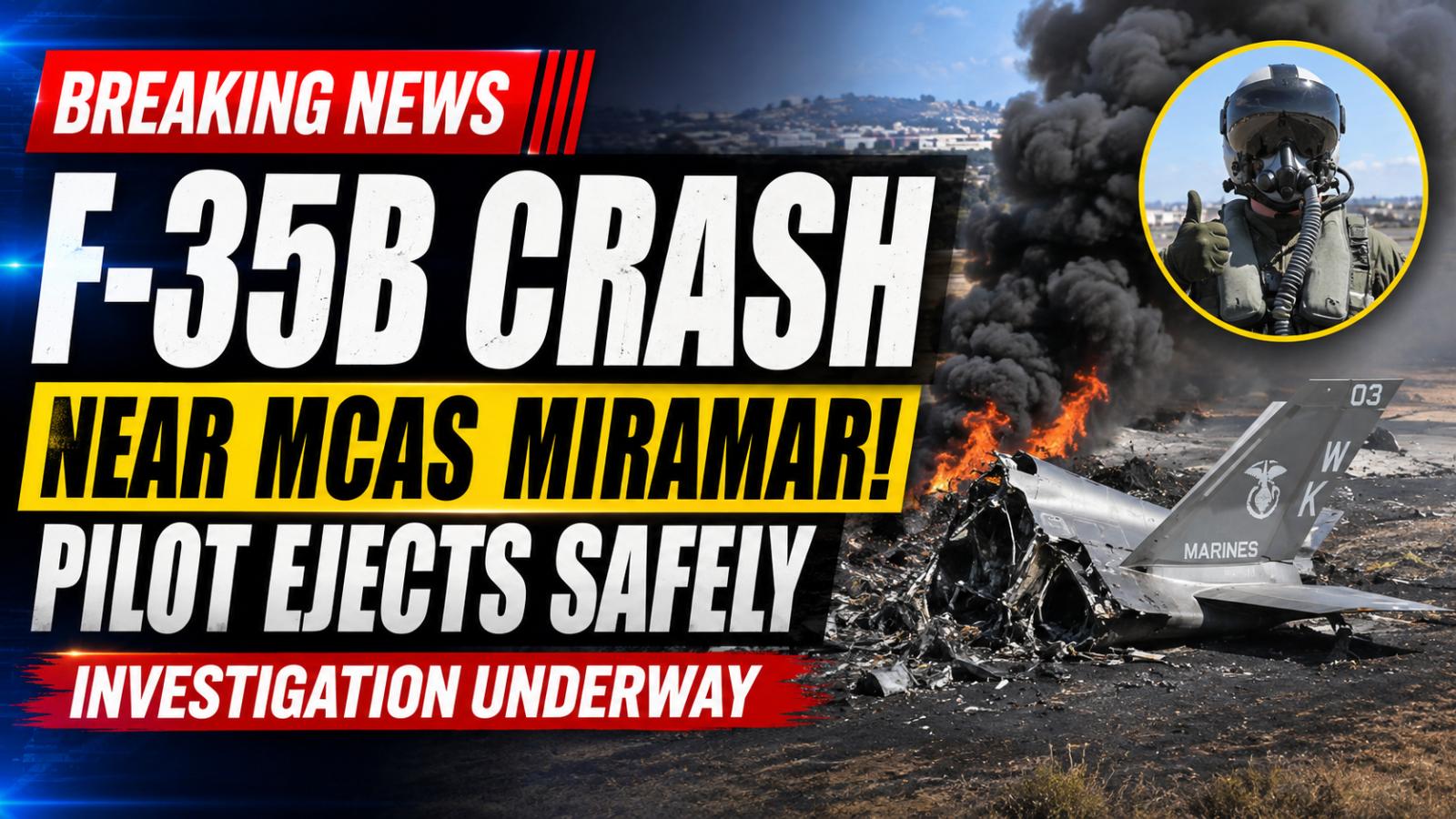
A US Marine Corps F-35B crash near MCAS Miramar in San Diego sparked a vegetation fire on Friday, July 31, 2026. The pilot ejected moments before impact and was taken to a medical facility in stable condition as military officials began investigating the accident.
Pilot Ejects Safely Before Impact
The F-35B went down near the flight line at Marine Corps Air Station Miramar at approximately 10 a.m. local time. The Marine Corps confirmed that the pilot successfully ejected before the aircraft struck the ground.
Emergency personnel recovered the pilot and transported the individual to a local medical facility for evaluation and treatment. Officials later said the pilot was in stable condition with non-life-threatening injuries. The Marine Corps has not publicly identified the pilot.
Witness accounts indicated that the aircraft was close to the runway when it lost control. However, investigators have not confirmed the jet’s precise altitude, speed or flight configuration before the crash.
Miramar Jet Assigned to Marine Aviation Unit
The aircraft belonged to the 3rd Marine Aircraft Wing and Marine Aircraft Group 11, which operate from the San Diego air station. The F-35B is the short-takeoff and vertical-landing version of the F-35 Lightning II and serves as a central part of Marine Corps aviation operations.
Military officials described the incident as a Class A mishap. The Department of Defense uses this classification for the most serious accidents, including incidents involving the loss of an aircraft, fatalities or major property damage.
The designation reflects the severity of the aircraft loss and does not indicate that anyone died in the Miramar accident. Officials reported no fatalities, while the pilot survived with injuries that were not considered life-threatening.
Brush Fire Response Near the Air Base
The crash ignited a vegetation fire near the airfield, sending flames and dark smoke above the area. Emergency crews responded as the fire burned close to State Route 52, where passing drivers could see the smoke.
The San Diego Fire-Rescue Department assisted military emergency teams with the vegetation fire. Fire officials said the Marine Corps retained control of the crash site because the accident occurred under military jurisdiction.
Crews applied fire retardant and water around the wreckage to prevent the flames from spreading. Images from the scene showed damaged aircraft sections surrounded by scorched ground and emergency vehicles.
Crash Probe Examines Final Flight
The Marine Corps has opened an investigation into the F-35B crash. Investigators are expected to examine flight data, maintenance records, weather conditions, pilot communications and debris recovered from the site.
Officials have not confirmed whether the jet was taking off, approaching the runway, performing a training exercise or conducting another type of operation. They have also not identified any mechanical failure or pilot action as a possible cause.
Witness observations may help establish a timeline, but they cannot determine why the aircraft went down. The military investigation will provide the authoritative findings once technical specialists complete their review.
Marine Jet Accident Raises Safety Questions
The pilot’s successful ejection prevented the accident from becoming fatal, but the destruction of an advanced fighter aircraft makes the incident a significant military aviation loss. The immediate response also prevented the resulting brush fire from threatening nearby communities or major roads.
Operations around the affected section of MCAS Miramar may remain restricted while investigators document the wreckage and remove aircraft components. The Marine Corps has not announced when it will release additional findings.