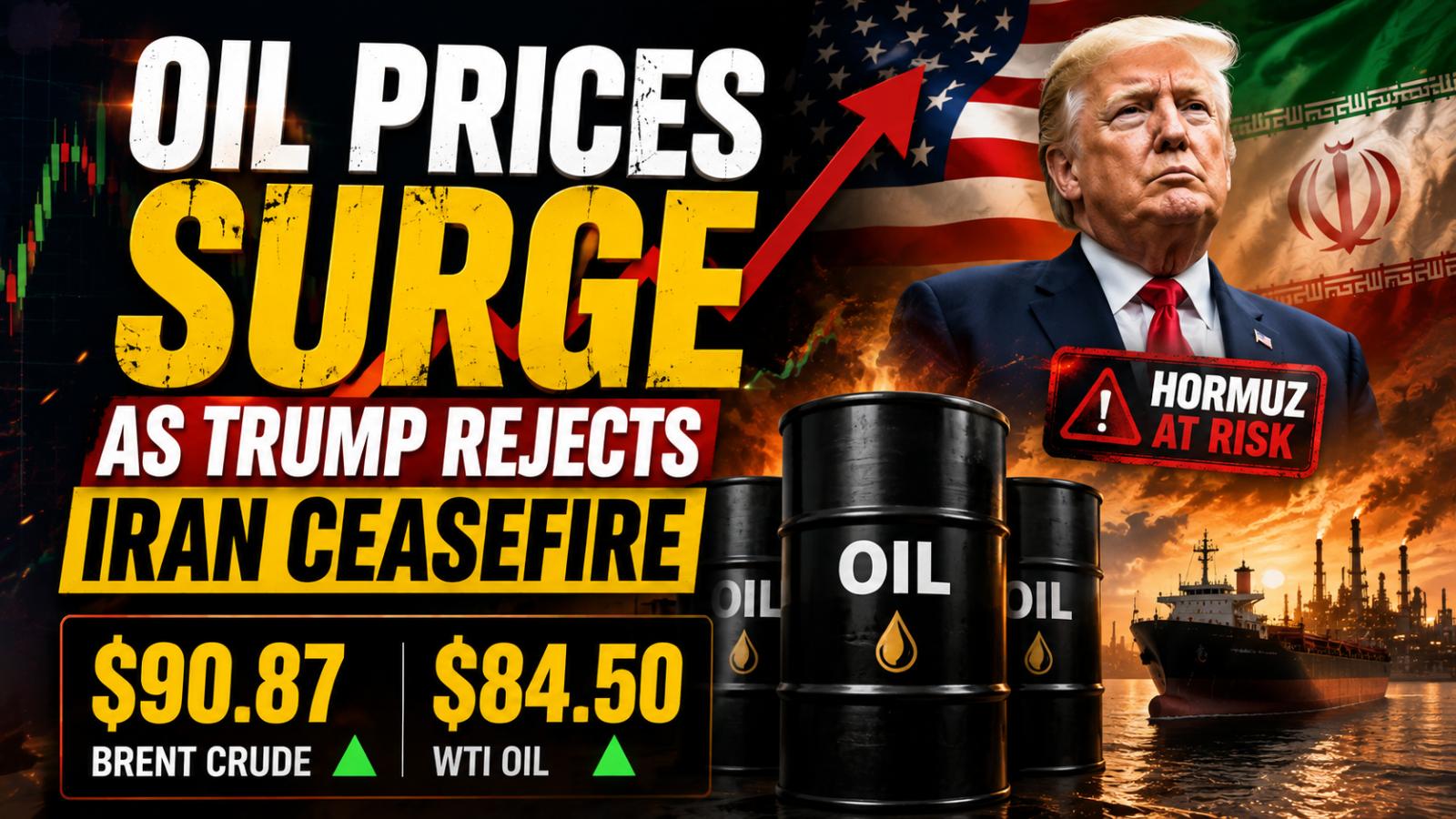
Oil prices surged on Monday as fading hopes for a US-Iran settlement renewed fears of prolonged supply disruptions in the Strait of Hormuz. Brent crude closed above $90 a barrel, while WTI oil also climbed sharply as traders reacted to stalled diplomacy and Iran's warning of possible military escalation.
Brent crude rises as Iran ceasefire hopes fade
Brent crude futures settled $2.22 higher at $90.87 a barrel on August 17, while US West Texas Intermediate gained $2.07 to finish at $84.50. The rally reflected growing concern that the conflict could continue to restrict oil flows from the Persian Gulf.
President Donald Trump said the United States would not extend the interim arrangement reached with Iran in June. That deal was intended to create a path toward a broader settlement involving Tehran's nuclear programme, sanctions and security conditions around the Strait of Hormuz.
The agreement had already weakened considerably before the deadline, however, and negotiations remained stalled as both governments hardened their positions.
For oil traders, the immediate consequence is increased uncertainty over how long disruptions in the Gulf could continue.
Hormuz risk remains biggest threat to oil supply
The Strait of Hormuz remains the central concern for global energy markets.
Before the conflict, the narrow waterway handled roughly one-fifth of global oil and gas shipments. US Energy Information Administration data has historically identified Hormuz as the world's most important oil transit chokepoint because of the enormous volume of petroleum moving through it.
Shipping activity has now fallen dramatically.
Kpler data cited by Reuters showed only five commodity vessels crossing the strait on Saturday, August 15, compared with 31 during the previous weekend. No commodity vessel crossings were recorded on Sunday.
Even when the waterway is not completely closed, fewer tanker movements can restrict exports, raise freight costs and push insurance premiums higher.
Iran ceasefire dispute raises escalation fears
Iran has also warned that it could shift from a defensive posture to a more aggressive military strategy if diplomacy fails.
A senior Iranian official said Tehran could take military action aimed at breaking the US naval blockade of the strait if Washington does not return to terms Iran considers acceptable.
That warning gives oil markets another reason to price in geopolitical risk. Any new attacks on tankers, ports or energy infrastructure could sharply reduce available supply or discourage shipping companies from entering the area.
Recent attacks on vessels have already contributed to the collapse in traffic through Hormuz. The United Arab Emirates has accused Iran of striking vessels operated by ADNOC, while other ships have reported security incidents in the waterway.
Oil market faces higher shipping and insurance costs
The disruption affects more than the physical amount of crude reaching buyers.
Tankers operating near conflict zones face higher insurance premiums, longer routes and additional security costs. Those expenses can eventually raise the delivered price of oil even when production itself remains available.
Major Gulf producers have some alternatives. Saudi Arabia and the United Arab Emirates can move limited volumes through pipelines that bypass Hormuz, but those routes cannot fully replace the normal capacity of the strait.
That leaves the global oil market highly sensitive to every diplomatic development involving Washington and Tehran.
Supply risks could keep crude prices volatile
The next direction for crude prices will depend heavily on whether diplomacy resumes.
Iran and Oman continue discussing arrangements linked to management of the strait, while back-channel contacts between Washington and Tehran have also been reported. But there is currently no clear sign of a comprehensive settlement.
Without progress, the market is likely to keep attaching a geopolitical premium to crude prices.
The fundamental issue is straightforward: Hormuz does not need to be completely shut to disrupt the market. A dramatic decline in tanker traffic alone can restrict supplies, increase transportation costs and make traders more concerned about the possibility of a wider confrontation.
Monday's move above $90 for Brent shows how quickly that risk can return to oil prices when diplomacy weakens.
For now, crude markets are once again being driven less by ordinary supply-and-demand forecasts and more by whether ships can safely move through one of the world's most important energy corridors.