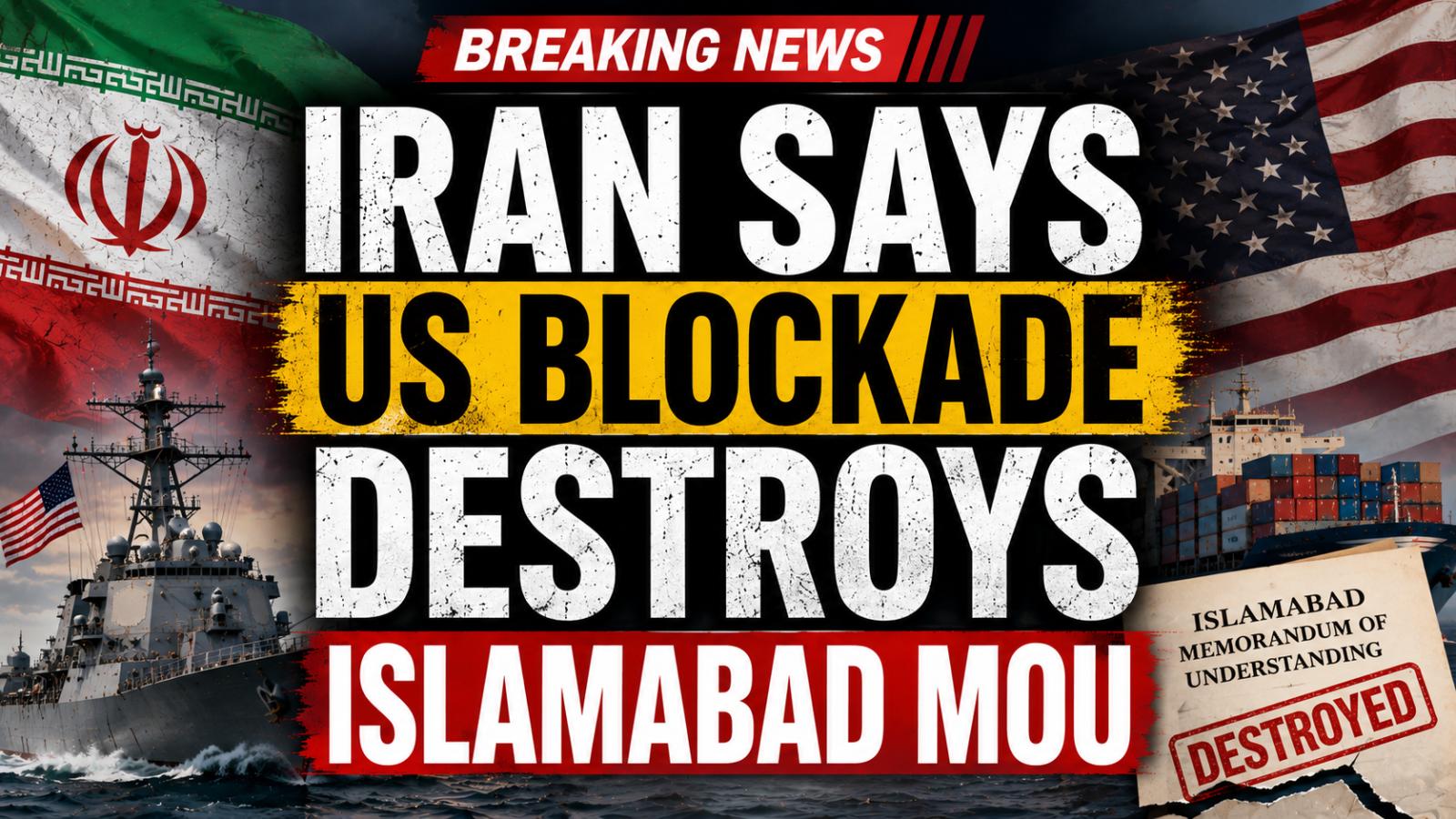
Iran Says US Naval Blockade Has Destroyed Islamabad MoU
Iran has declared that it no longer considers itself bound by the Islamabad Memorandum of Understanding after the United States resumed its naval blockade of Iranian ports. Deputy Foreign Minister Kazem Gharibabadi said Washington’s action had dismantled the fragile agreement designed to halt hostilities and support further peace negotiations.
Iran says Islamabad MoU has collapsed
Speaking to Iranian state media on Tuesday, July 14, Gharibabadi accused the United States of abandoning the commitments it had accepted under the Islamabad MoU. He argued that describing the renewed blockade as a simple violation failed to reflect the seriousness of Washington’s decision.
“The US has not merely violated the Memorandum of Understanding,” Gharibabadi said, according to the state media account. He added that the resumption of the blockade had “completely dismantled” the agreement and meant Iran was no longer bound by its terms.
His remarks represent Tehran’s official position on the latest escalation. The United States had not immediately issued a detailed response to his claim that the MoU was no longer valid.
US naval blockade resumes against Iranian ports
US Central Command confirmed that American forces would resume blockading maritime traffic entering and leaving Iranian ports from 4 p.m. Eastern Time on July 14. CENTCOM said the operation would apply to vessels travelling to or from Iranian ports and coastal areas.
The command said commercial vessels that did not violate the blockade could continue moving through regional waters. However, the measure raises new concerns for shipping companies operating near the Gulf of Oman and the Strait of Hormuz.
The blockade marks a major military escalation after a temporary pause in fighting. It also places additional pressure on Iran’s trade routes at a time when both countries are increasing military and economic measures against each other.
Peace agreement had briefly halted hostilities
The United States and Iran signed the Islamabad Memorandum of Understanding on June 18, 2026, following negotiations facilitated by Pakistan. The interim framework was intended to stop military attacks, reopen the Strait of Hormuz and create room for further diplomatic talks.
Pakistan described the agreement as an important foundation for regional stability. The country later urged both Washington and Tehran to uphold their commitments after President Donald Trump said in early July that the interim arrangement was over.
The MoU did not resolve the deeper disputes between the two countries. Questions involving Iran’s nuclear programme, US sanctions, maritime security and future political guarantees remained open for later negotiations.
Iran US tensions threaten further escalation
Gharibabadi’s declaration creates fresh uncertainty over whether any part of the Islamabad framework can survive. If Tehran formally abandons its obligations, the risk of renewed attacks on military targets, shipping routes and regional infrastructure could increase.
Neither side has announced an immediate return to negotiations. Washington continues to describe its military actions as necessary to protect shipping and counter Iranian threats, while Tehran accuses the United States of violating a diplomatic understanding and expanding the conflict.
The renewed blockade does not automatically prove that diplomacy has permanently ended. Pakistan or other regional mediators could still attempt to restore communication. However, Iran’s statement shows that the limited trust created by the Islamabad MoU has largely disappeared, leaving the Gulf region facing a renewed period of military and commercial uncertainty.