Seizure of Majestic X in Indian Ocean amid rising tensions
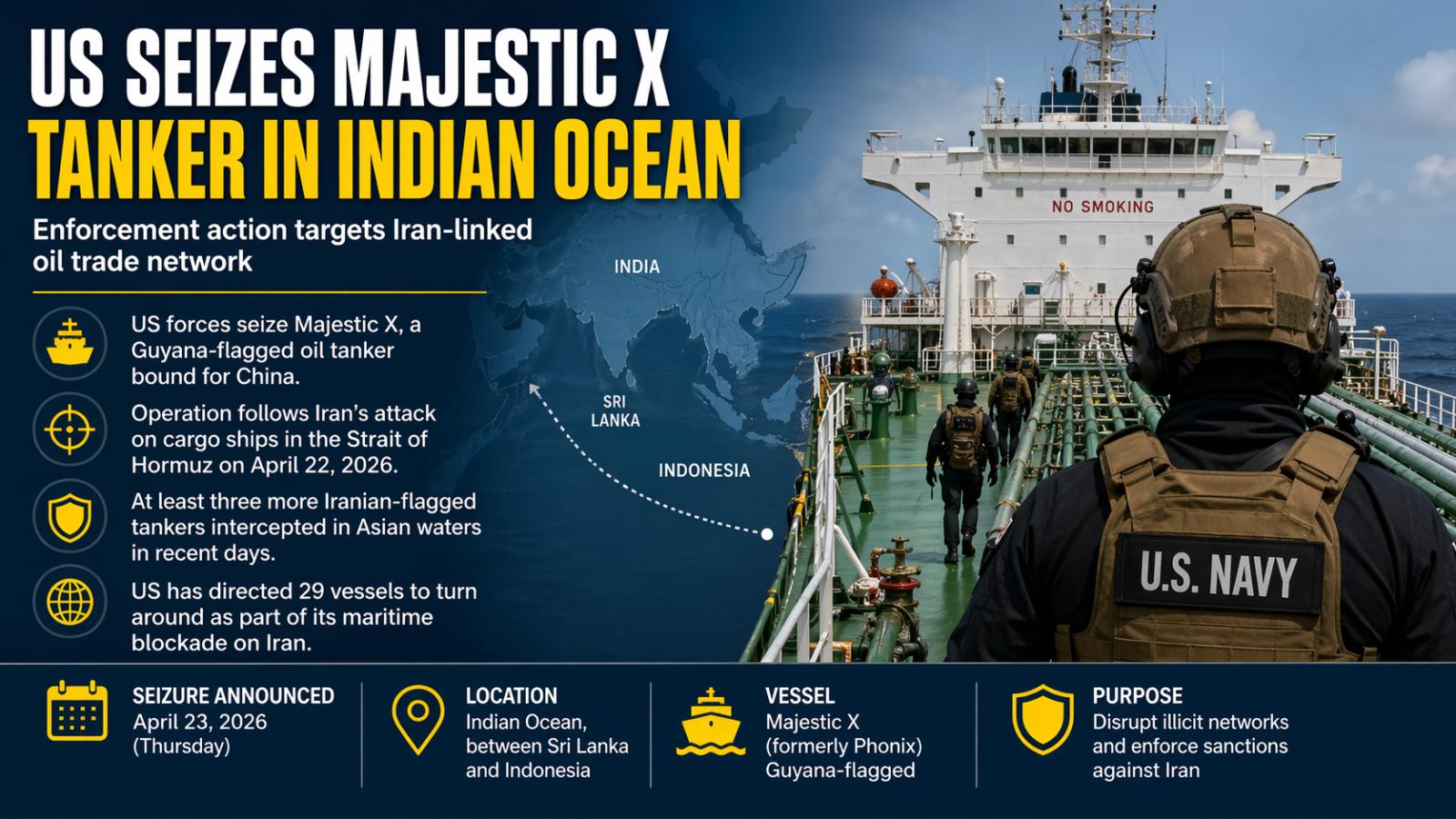
The U.S. Department of Defense announced on Thursday, April 23, 2026, that it seized the oil tanker Majestic X in the Indian Ocean while it was en route to Zhoushan, China. Officials said the operation is part of ongoing maritime enforcement aimed at disrupting networks linked to Iranian oil exports in violation of U.S. sanctions.
The Pentagon released video footage showing U.S. troops boarding and securing the vessel. Ship-tracking data placed the tanker between Sri Lanka and Indonesia, an area where U.S. forces have recently increased activity. The Majestic X, sailing under a Guyana flag, was previously known as Phonix and had been sanctioned in 2024 for transporting Iranian crude.
Iran-linked attacks trigger expanded U.S. maritime operations
The seizure followed escalating tensions after Iran attacked three cargo ships on Wednesday, April 22, 2026, in the Strait of Hormuz, capturing two vessels. In response, U.S. officials indicated they would continue targeting ships suspected of supporting Iran’s oil trade, even outside the high-risk Gulf region.
Defense officials said operations are increasingly shifting to open waters in the Indian Ocean to reduce the threat posed by naval mines in the Strait of Hormuz, a critical global shipping route.
Multiple tanker interceptions reported across Asian waters
Shipping and security sources reported that U.S. forces have intercepted at least three additional Iranian-flagged tankers in recent days. These vessels were operating near India, Malaysia, and Sri Lanka before being redirected. Among them was the supertanker Deep Sea, partially loaded with crude, and the smaller tanker Sevin, which was carrying about 65% of its capacity.
Another vessel, the fully loaded supertanker Dorena, was tracked off southern India before coming under escort by a U.S. Navy destroyer in the Indian Ocean.
Expanding blockade reshapes regional oil shipping routes
U.S. officials confirmed that since initiating the maritime blockade, forces have directed at least 29 vessels to alter course or return to port. The measures are part of broader efforts to limit Iran’s ability to export oil by sea, while Iran has responded with aggressive actions aimed at disrupting shipping through the Strait of Hormuz.
The situation underscores growing volatility in global shipping lanes, particularly across Asia, as enforcement actions and retaliatory measures continue to reshape oil trade routes and maritime security dynamics.