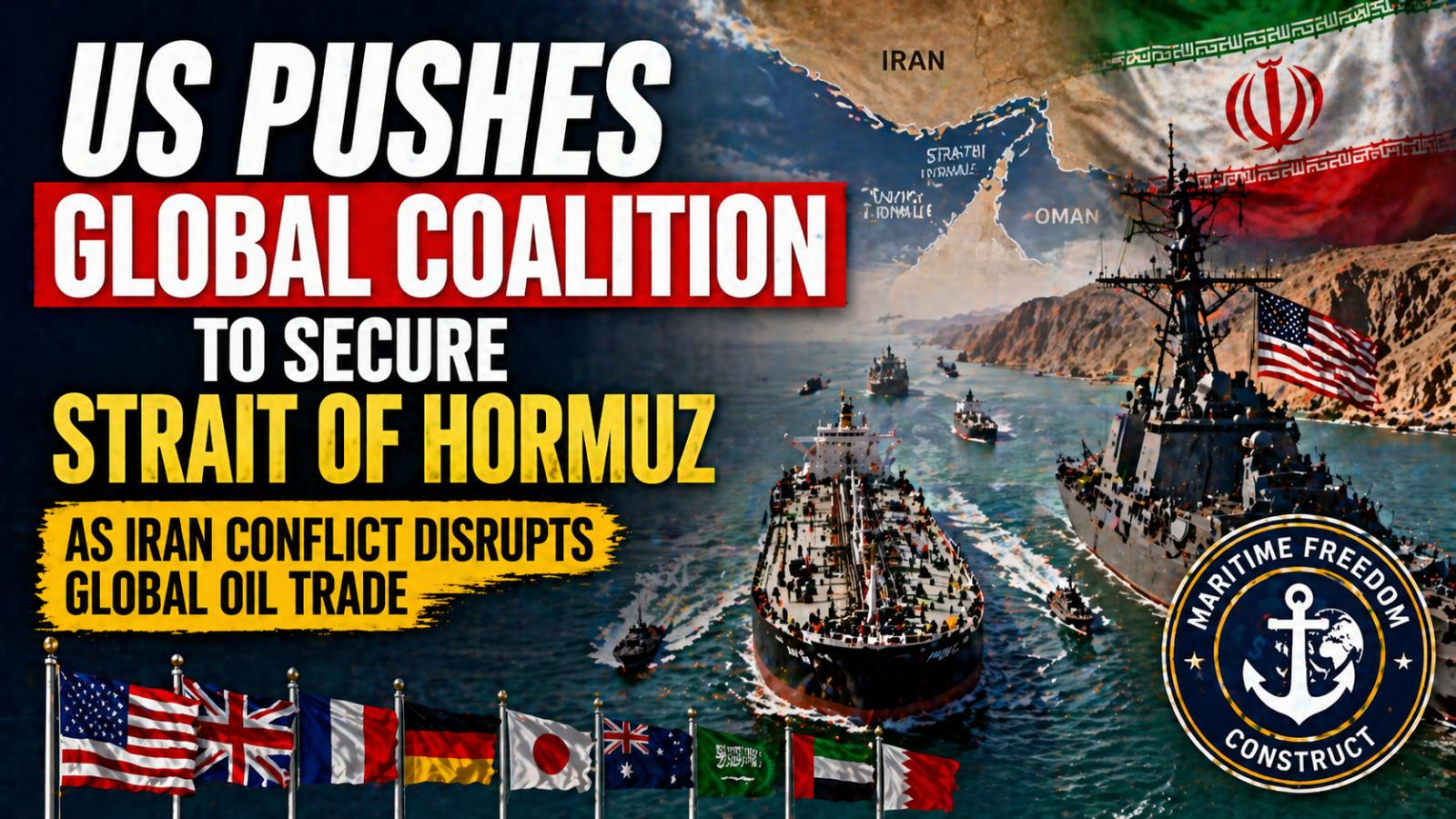
The United States is accelerating efforts to form a global coalition to secure the Strait of Hormuz, as the ongoing US-Iran conflict continues to disrupt critical shipping routes and drive volatility in global oil trade. The initiative, known as the Maritime Freedom Construct, aims to coordinate international maritime security, sanctions policy, and intelligence sharing to ensure safe navigation through one of the world’s most strategic waterways.
The Strait of Hormuz, a narrow passage linking the Persian Gulf to global markets, carries a significant portion of the world’s oil supply. Recent tensions between the United States and Iran have led to competing naval blockades, raising serious concerns about energy security and the stability of global trade. The disruption has already triggered an oil prices surge, impacting economies and increasing pressure on governments to respond.
US diplomats have been instructed to urgently engage partner nations and secure participation in the coalition, positioning it as a collective effort to protect shipping routes and stabilize the global economy. The strategy emphasizes flexibility, allowing countries to contribute based on their military capabilities, logistical strength, and strategic interests. Officials say this approach is designed to maximize participation while maintaining operational effectiveness.
The coalition will be jointly led by the Departments of State and Defense, operating through US Central Command, and is expected to integrate closely with existing naval forces in the region. The broader goal is to strengthen maritime security while reinforcing deterrence against further disruptions in the Strait of Hormuz. At the same time, the United States has instructed diplomats to avoid engagement with adversarial nations, reflecting the geopolitical sensitivity surrounding the initiative.
President Donald Trump has taken a complex stance on the coalition effort, at times asserting that US naval forces can independently manage the situation while also criticizing allies, particularly in Europe, for not contributing enough to regional security. This mixed messaging highlights ongoing divisions within Western alliances and underscores the challenges of building a unified response to the Middle East crisis.
Parallel initiatives led by European nations, including the United Kingdom and France, are also underway, focusing on coordinated naval planning and potential deployment of military assets. These efforts are expected to complement the US-led coalition, creating a layered framework aimed at restoring stability in global shipping routes and protecting energy flows.
The stakes remain high as the Strait of Hormuz continues to serve as a critical chokepoint for global oil trade. Any prolonged disruption could have far-reaching consequences, from rising fuel costs to broader economic instability. Analysts note that maintaining uninterrupted access to the waterway is essential not only for regional stability but also for the functioning of the global economy.
As diplomatic outreach intensifies, the success of the Maritime Freedom Construct will depend on the willingness of international partners to align with US strategy and commit resources. The development signals a broader shift in US foreign policy toward coalition-based maritime security, reflecting the growing importance of safeguarding global trade routes in an increasingly volatile geopolitical environment.