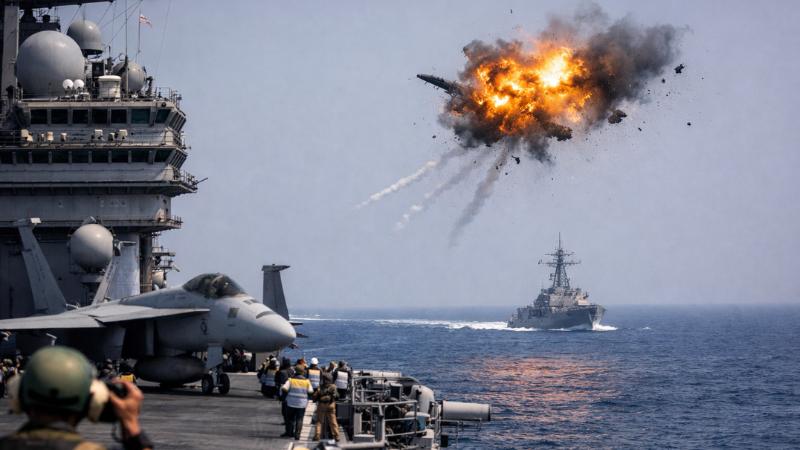
Tensions between Iran and the United States intensified this week after the US military shot down an Iranian drone that it said approached the aircraft carrier USS Abraham Lincoln in an aggressive manner in the Arabian Sea. The incident came as both sides exchanged sharp warnings and cautious signals about a possible return to nuclear diplomacy, underscoring the fragile balance between confrontation and negotiation in the region.
According to US officials, the drone was intercepted after it moved close to the carrier group operating in the Gulf waters, raising concerns over the safety of American personnel and assets. The shootdown followed statements from President Donald Trump, who warned that “bad things” could happen if Tehran failed to reach a new nuclear agreement with Washington. He said powerful US warships were moving closer to Iran and expressed hope that negotiations would still produce an acceptable outcome.
Despite the rising rhetoric, the White House indicated that diplomatic channels remain open. Spokesperson Karoline Leavitt said US envoy Steve Witkoff is expected to hold conversations with Iranian representatives later this week, suggesting that both governments are still exploring avenues for dialogue even as military posturing continues.
Iranian authorities acknowledged the loss of the drone and said the Islamic Revolutionary Guard Corps is investigating what it described as an interruption to the aircraft. Reports in Iranian media claimed the drone had successfully transmitted surveillance images before contact was lost. President Masoud Pezeshkian reiterated that Tehran is prepared to negotiate, provided talks take place in what he called a suitable environment free from threats, with Oman proposed as a preferred venue.
The drone incident follows earlier maritime friction in the Strait of Hormuz, where Iranian forces reportedly attempted to detain a US-flagged tanker. The strategic waterway remains a critical corridor for global energy supplies, and any disruption there quickly heightens international concern. Washington has previously targeted Iranian nuclear facilities, with Trump asserting that key sites were destroyed, a claim Tehran disputes.
Amid the diplomatic uncertainty, reports indicate that Iranian officials have privately discussed the possibility of suspending or limiting parts of their nuclear programme to ease pressure. At the same time, Iran’s Supreme Leader Ayatollah Ali Khamenei accused the United States and Israel of fueling unrest inside the country, describing recent protests as externally influenced while distinguishing them from economic grievances raised by traders.
Relations between the two countries have deteriorated since late last year, when economic protests in Tehran broadened into wider criticism of the government. While Washington voiced support for demonstrators, Iranian leaders framed the unrest as foreign interference. Analysts warn that continued military incidents, combined with stalled nuclear talks and regional mistrust, could push both sides toward deeper confrontation unless diplomacy gains traction in the coming weeks.