Google has withdrawn a newly launched image-generation feature from Google Earth after users demonstrated how it could create convincing but fictional satellite-style scenes. The Google Earth AI image tool lasted less than a day before concerns over fake satellite images, policy violations and online disinformation forced the company to reverse course.
Google Earth AI Tool Removed After One Day
Google has withdrawn a newly launched image-generation feature from Google Earth after users demonstrated how it could create convincing but fictional satellite-style scenes. The Google Earth AI image tool lasted less than a day before concerns over fake satellite images, policy violations and online disinformation forced the company to reverse course.
Google Earth AI Tool Removed After One Day
Russia is reportedly providing Iran with satellite surveillance and signals intelligence that could strengthen Tehran’s air defences, protect military assets and improve the accuracy of its drone and missile operations. The claims come from US and European officials, but neither Moscow nor Tehran has confirmed the alleged cooperation.
Russian Satellite Data May Strengthen Iran Air Defence
Off
Russia is reportedly providing Iran with satellite surveillance and signals intelligence that could strengthen Tehran’s air defences, protect military assets and improve the accuracy of its drone and missile operations. The claims come from US and European officials, but neither Moscow nor Tehran has confirmed the alleged cooperation.
Russian Satellite Data May Strengthen Iran Air Defence
Off
Skyroot Aerospace is preparing Vikram-1 for its maiden orbital mission from Sriharikota. Scheduled for July 18, 2026, the launch could mark India’s first privately developed orbital rocket flight and strengthen the country’s commercial small-satellite launch sector.
The Vikram-1 first orbital launch is scheduled for 11:30 a.m. IST on Saturday, July 18, 2026, from the Satish Dhawan Space Centre in Sriharikota, Andhra Pradesh. Through Missio
Skyroot Aerospace is preparing Vikram-1 for its maiden orbital mission from Sriharikota. Scheduled for July 18, 2026, the launch could mark India’s first privately developed orbital rocket flight and strengthen the country’s commercial small-satellite launch sector.
The Vikram-1 first orbital launch is scheduled for 11:30 a.m. IST on Saturday, July 18, 2026, from the Satish Dhawan Space Centre in Sriharikota, Andhra Pradesh. Through Missio
China has constructed a detailed, full-scale target resembling a US Navy Arleigh Burke-class guided-missile destroyer at a remote testing range in Xinjiang. Satellite imagery attributed to US geospatial company Vantor suggests the model could help China study missile targeting, surveillance and strike coordination against a moving naval platform.
Desert Target Shows Greater Structural Detail
The China ship repl
China has constructed a detailed, full-scale target resembling a US Navy Arleigh Burke-class guided-missile destroyer at a remote testing range in Xinjiang. Satellite imagery attributed to US geospatial company Vantor suggests the model could help China study missile targeting, surveillance and strike coordination against a moving naval platform.
Desert Target Shows Greater Structural Detail
The China ship repl
Iran nuclear site repairs appear to be underway at Taleghan 2, Parchin and Pickaxe Mountain after recent US-Israeli strikes. Satellite imagery shows cranes, vehicles and cleared impact areas, but Iran and international inspectors have not confirmed the work’s purpose.
Taleghan 2 repairs visible in satellite imagery
Recent high-resolution satellite images indicate repair and rehabilitation activity at Taleghan
Iran nuclear site repairs appear to be underway at Taleghan 2, Parchin and Pickaxe Mountain after recent US-Israeli strikes. Satellite imagery shows cranes, vehicles and cleared impact areas, but Iran and international inspectors have not confirmed the work’s purpose.
Taleghan 2 repairs visible in satellite imagery
Recent high-resolution satellite images indicate repair and rehabilitation activity at Taleghan
The Indo-Pacific strategy is increasingly moving away from traditional security frameworks toward digital infrastructure control. Japan and India are emerging as key drivers in this transition, focusing on secure data movement, resilient communication systems, and long-term technological independence from concentrated global networks. The shift reflects a broader attempt to reduce vulnerabilities in cross-border data flows and critical digital assets.
The Indo-Pacific strategy is increasingly moving away from traditional security frameworks toward digital infrastructure control. Japan and India are emerging as key drivers in this transition, focusing on secure data movement, resilient communication systems, and long-term technological independence from concentrated global networks. The shift reflects a broader attempt to reduce vulnerabilities in cross-border data flows and critical digital assets.
A Chinese reusable spacecraft linked to the Shenlong program has triggered fresh global scrutiny after tracking data showed a separate object appearing in close proximity during its latest orbital phase. The event, observed in June 2026, has added new uncertainty around the nature of China’s secretive spaceplane operations.
Tracking data reveals unexpected separation in orbit
Independent space surveillance firm LeoLabs reported detection of a new object near the Shenlong spacecraft during routine orbital monitoring. The timing and proximity suggested a possible release or separation event from the main vehicle. The object was later incorporated into the US Space Force satellite catalog, allowing continued tracking through global space surveillance networks.
What the Shenlong spaceplane is designed for
Shenlong spaceplane is China’s experimental reusable orbital vehicle designed to launch via rocket and return to Earth like a conventional aircraft. The system is believed to support long-duration missions involving orbital testing, reconnaissance experiments, and reusable spacecraft technologies. It is often compared to the US X-37B program due to its similar operational profile and secrecy surrounding mission objectives.
Launch background and mission profile
The spacecraft associated with this mission was launched from the Jiuquan Satellite Launch Center aboard a Long March 2F rocket. Since launch, Chinese authorities have released minimal operational details, leaving external analysts to rely heavily on radar tracking, orbital behavior, and third-party observations to interpret mission activity.
Why the object detection raised questions
The appearance of a separate object in close orbital proximity has led analysts to consider several possibilities, including experimental deployment, satellite servicing tests, or controlled separation of hardware. While none of these scenarios have been confirmed, the pattern aligns with rendezvous and proximity operations (RPO), a capability used for inspecting or interacting with objects in space.
Strategic implications and global monitoring
The development is being closely monitored because RPO technology has dual-use applications. It can support peaceful maintenance missions but also enable advanced surveillance or counter-space capabilities. As a result, both US and international tracking systems continue to observe Shenlong missions for behavioral patterns that may indicate evolving strategic capabilities.
Ongoing uncertainty around mission details
Despite growing external analysis, no official clarification has been issued regarding the nature of the detected object. This lack of transparency keeps the mission under active observation, with each new orbital event contributing to broader assessments of China’s reusable spacecraft program and its long-term strategic direction.
A Chinese reusable spacecraft linked to the Shenlong program has triggered fresh global scrutiny after tracking data showed a separate object appearing in close proximity during its latest orbital phase. The event, observed in June 2026, has added new uncertainty around the nature of China’s secretive spaceplane operations.
Tracking data reveals unexpected separation in orbit
Independent space surveillance firm LeoLabs reported detection of a new object near the Shenlong spacecraft during routine orbital monitoring. The timing and proximity suggested a possible release or separation event from the main vehicle. The object was later incorporated into the US Space Force satellite catalog, allowing continued tracking through global space surveillance networks.
What the Shenlong spaceplane is designed for
Shenlong spaceplane is China’s experimental reusable orbital vehicle designed to launch via rocket and return to Earth like a conventional aircraft. The system is believed to support long-duration missions involving orbital testing, reconnaissance experiments, and reusable spacecraft technologies. It is often compared to the US X-37B program due to its similar operational profile and secrecy surrounding mission objectives.
Launch background and mission profile
The spacecraft associated with this mission was launched from the Jiuquan Satellite Launch Center aboard a Long March 2F rocket. Since launch, Chinese authorities have released minimal operational details, leaving external analysts to rely heavily on radar tracking, orbital behavior, and third-party observations to interpret mission activity.
Why the object detection raised questions
The appearance of a separate object in close orbital proximity has led analysts to consider several possibilities, including experimental deployment, satellite servicing tests, or controlled separation of hardware. While none of these scenarios have been confirmed, the pattern aligns with rendezvous and proximity operations (RPO), a capability used for inspecting or interacting with objects in space.
Strategic implications and global monitoring
The development is being closely monitored because RPO technology has dual-use applications. It can support peaceful maintenance missions but also enable advanced surveillance or counter-space capabilities. As a result, both US and international tracking systems continue to observe Shenlong missions for behavioral patterns that may indicate evolving strategic capabilities.
Ongoing uncertainty around mission details
Despite growing external analysis, no official clarification has been issued regarding the nature of the detected object. This lack of transparency keeps the mission under active observation, with each new orbital event contributing to broader assessments of China’s reusable spacecraft program and its long-term strategic direction.
Indian Space Startups Strengthen NavIC Push With Eyes And Ears In Orbit
India’s private space companies are no longer just supporting Isro — they are building satellites that could help the country watch borders, track signals, and strengthen NavIC.
At the India Space Congress 2026 in New Delhi, several Indian firms showcased satellite technologies focused on surveillance, si
Indian Space Startups Strengthen NavIC Push With Eyes And Ears In Orbit
India’s private space companies are no longer just supporting Isro — they are building satellites that could help the country watch borders, track signals, and strengthen NavIC.
At the India Space Congress 2026 in New Delhi, several Indian firms showcased satellite technologies focused on surveillance, si
Pakistan’s rapid satellite expansion with Chinese support is raising fresh security concerns in India, as analysts warn that the South Asian rivalry is increasingly moving into space.
More than a year after India launched Operation Sindoor on Wednesday, May 7, 2025, following the Pahalgam terror attack on Tuesday, April 22, 2025, a quieter contest is unfolding hundreds of kilometers above Earth.
Pakistan Expands Earth-Observation Satellite Network
Pakistan’s rapid satellite expansion with Chinese support is raising fresh security concerns in India, as analysts warn that the South Asian rivalry is increasingly moving into space.
More than a year after India launched Operation Sindoor on Wednesday, May 7, 2025, following the Pahalgam terror attack on Tuesday, April 22, 2025, a quieter contest is unfolding hundreds of kilometers above Earth.
Pakistan Expands Earth-Observation Satellite Network
SpaceX Eyes Historic IPO
Elon Musk-led SpaceX is preparing to raise approximately $75 billion through an initial public offering, according to a regulatory filing released on June 3. If completed, the IPO would value the company at around $1.765 trillion, placing SpaceX among the most valuable corporations globally. The offering plans to sell 555,555,555 shares at $135 per share, leveraging nearly 13 billio
SpaceX Eyes Historic IPO
Elon Musk-led SpaceX is preparing to raise approximately $75 billion through an initial public offering, according to a regulatory filing released on June 3. If completed, the IPO would value the company at around $1.765 trillion, placing SpaceX among the most valuable corporations globally. The offering plans to sell 555,555,555 shares at $135 per share, leveraging nearly 13 billio
Iran has carried out a series of coordinated attacks on U.S. military bases across the Middle East, striking facilities in multiple countries simultaneously. Satellite assessments suggest significant damage to critical infrastructure, including radar installations, air defense systems, and support aircraft. Analysts describe these operations as highly precise, signaling a new phase in Tehran’s regional military strategy.
Iran has carried out a series of coordinated attacks on U.S. military bases across the Middle East, striking facilities in multiple countries simultaneously. Satellite assessments suggest significant damage to critical infrastructure, including radar installations, air defense systems, and support aircraft. Analysts describe these operations as highly precise, signaling a new phase in Tehran’s regional military strategy.
SpaceX has officially submitted its initial public offering (IPO), targeting a valuation exceeding $80 billion. The filing outlines the company’s board structure, revenue performance, Starlink broadband expansion, and upcoming orbital AI projects. This IPO is positioned to be among the largest in history, aiming to surpass previous records in the aerospace and tech sector.
Massive Market Opportunity for SpaceX
The comp
SpaceX has officially submitted its initial public offering (IPO), targeting a valuation exceeding $80 billion. The filing outlines the company’s board structure, revenue performance, Starlink broadband expansion, and upcoming orbital AI projects. This IPO is positioned to be among the largest in history, aiming to surpass previous records in the aerospace and tech sector.
Massive Market Opportunity for SpaceX
The comp
Fresh satellite imagery has sparked renewed scrutiny over Pakistan's involvement in the ongoing US-Iran diplomatic talks, with reports suggesting that Islamabad may be housing at least one Iranian military aircraft at the strategically important Nur Khan Airbase, located near Islamabad. These developments come amid heightened tensions between Washington and Tehran, as Pakistan continues to position itself as a mediator between the two nations.
The satellite images, which are believe
Fresh satellite imagery has sparked renewed scrutiny over Pakistan's involvement in the ongoing US-Iran diplomatic talks, with reports suggesting that Islamabad may be housing at least one Iranian military aircraft at the strategically important Nur Khan Airbase, located near Islamabad. These developments come amid heightened tensions between Washington and Tehran, as Pakistan continues to position itself as a mediator between the two nations.
The satellite images, which are believe
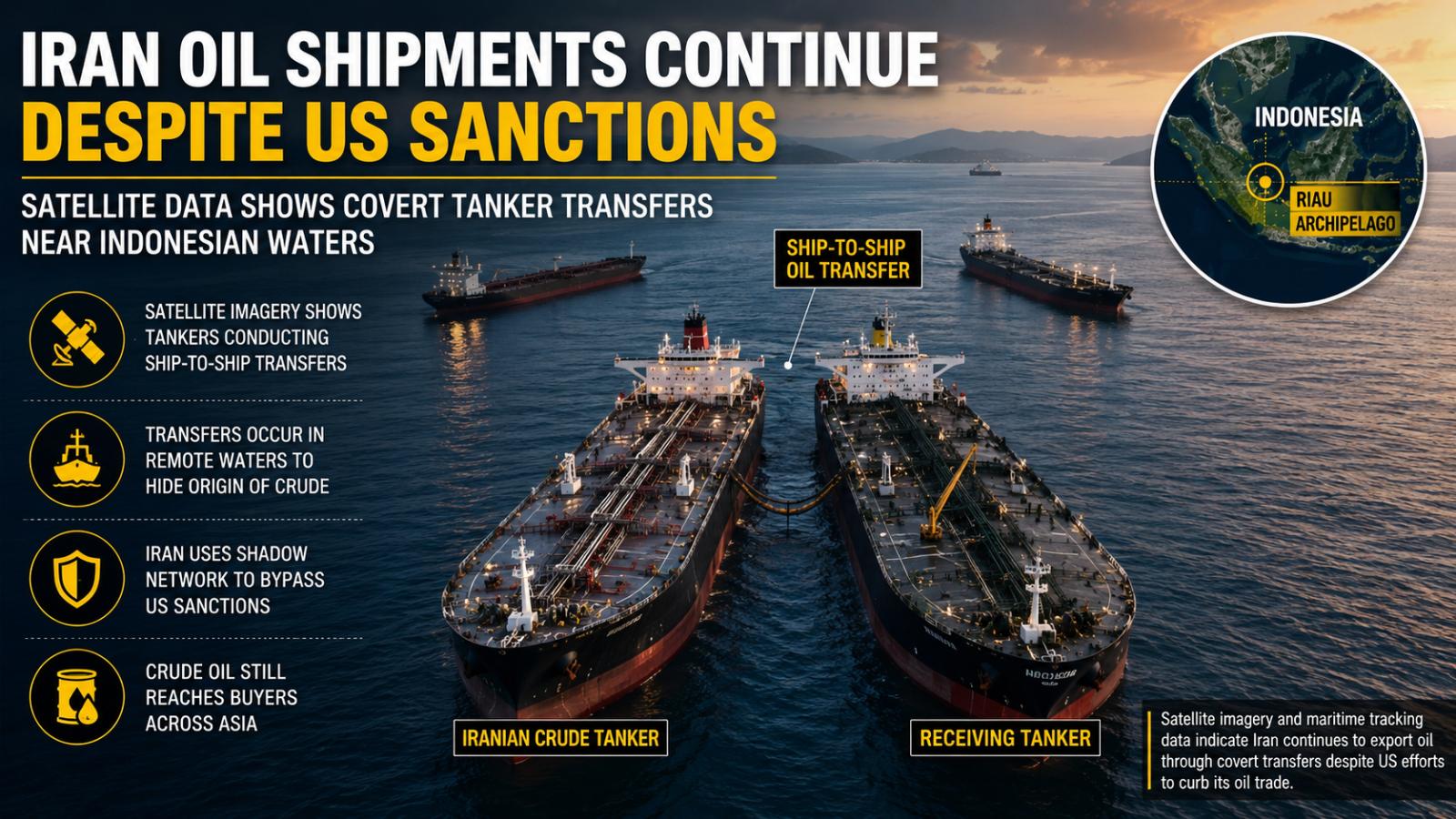
Iran oil shipments are continuing despite tighter U.S. sanctions, with satellite imagery and maritime tracking data suggesting Tehran is still moving crude through covert sea transfers.
The findings point to an active shadow shipping network that allows Iranian oil to reach buyers in Asia even as Washington works to restrict crude exports from the Persian Gulf.
Satellite Data Points To Covert Tanker Transfers
Maritime tracking records and satel
Iran oil shipments are continuing despite tighter U.S. sanctions, with satellite imagery and maritime tracking data suggesting Tehran is still moving crude through covert sea transfers.
The findings point to an active shadow shipping network that allows Iranian oil to reach buyers in Asia even as Washington works to restrict crude exports from the Persian Gulf.
Satellite Data Points To Covert Tanker Transfers
Maritime tracking records and satel
The Washington Post has reported, based on satellite imagery analysis, that Iranian airstrikes have severely damaged or destroyed at least 228 structures and pieces of equipment at U.S. military sites across the Gulf region since the conflict began on February 28. This number far exceeds the figures acknowledged by the U.S. government. The strikes affected 15 U.S. military sites in Kuwait, Bahrain, Qatar, Saudi Arabia, Jordan, and the UAE.
Satellite images from Iranian state-affiliated media, along with 109 images from the EU's Copernicus satellite system and commercial sources, provided evidence of the scale of the damage. The investigation uncovered damage to 217 structures and 11 pieces of equipment, including hangars, barracks, fuel depots, aircraft, radar systems, and air defense equipment. In total, seven U.S. service members were killed in attacks on regional bases, six in Kuwait and one in Saudi Arabia, while more than 400 troops were injured by late April. Of the injured, 12 sustained serious injuries.
More than half of the documented damage occurred at the U.S. 5th Fleet headquarters in Bahrain and major U.S. facilities in Kuwait. Iranian forces targeted critical infrastructure, including fuel bladders and Patriot missile defense systems at Ali al-Salem Air Base in Kuwait. Attacks also hit barracks, power infrastructure, and operational facilities at Camp Arifjan and Camp Buehring in Kuwait. Other U.S. sites, such as Al-Udeid Air Base in Qatar and naval facilities in Bahrain, saw significant damage to satellite communications infrastructure.
Iran’s airstrikes have demonstrated a higher degree of precision than expected. Mark Cancian of the Center for Strategic and International Studies noted that "there are no random craters indicating misses," suggesting that the attacks were highly targeted.
This precision has placed considerable strain on U.S.-made defense systems in the Gulf. Between February 28 and April 8, U.S. forces used at least 190 THAAD interceptors, nearly 53% of their pre-war inventory, and 1,060 Patriot interceptors, about 43% of their pre-war stock. Despite these efforts, U.S. air defenses have struggled to cope with modern drone warfare, where one-way attack drones are difficult to intercept yet highly accurate.
The strikes have forced U.S. commanders to relocate personnel from bases at risk, with some U.S. officials describing the damage at the Naval Support Activity Bahrain as “extensive.” Personnel from the site have been relocated to MacDill Air Force Base in Tampa, Florida. The U.S. Central Command declined to provide further counter-assessments, citing the need for a complete evaluation after the conflict ends.
This extensive damage underscores the ongoing challenges faced by U.S. forces in the Gulf and highlights the evolving nature of modern warfare.
The Washington Post has reported, based on satellite imagery analysis, that Iranian airstrikes have severely damaged or destroyed at least 228 structures and pieces of equipment at U.S. military sites across the Gulf region since the conflict began on February 28. This number far exceeds the figures acknowledged by the U.S. government. The strikes affected 15 U.S. military sites in Kuwait, Bahrain, Qatar, Saudi Arabia, Jordan, and the UAE.
Satellite images from Iranian state-affiliated media, along with 109 images from the EU's Copernicus satellite system and commercial sources, provided evidence of the scale of the damage. The investigation uncovered damage to 217 structures and 11 pieces of equipment, including hangars, barracks, fuel depots, aircraft, radar systems, and air defense equipment. In total, seven U.S. service members were killed in attacks on regional bases, six in Kuwait and one in Saudi Arabia, while more than 400 troops were injured by late April. Of the injured, 12 sustained serious injuries.
More than half of the documented damage occurred at the U.S. 5th Fleet headquarters in Bahrain and major U.S. facilities in Kuwait. Iranian forces targeted critical infrastructure, including fuel bladders and Patriot missile defense systems at Ali al-Salem Air Base in Kuwait. Attacks also hit barracks, power infrastructure, and operational facilities at Camp Arifjan and Camp Buehring in Kuwait. Other U.S. sites, such as Al-Udeid Air Base in Qatar and naval facilities in Bahrain, saw significant damage to satellite communications infrastructure.
Iran’s airstrikes have demonstrated a higher degree of precision than expected. Mark Cancian of the Center for Strategic and International Studies noted that "there are no random craters indicating misses," suggesting that the attacks were highly targeted.
This precision has placed considerable strain on U.S.-made defense systems in the Gulf. Between February 28 and April 8, U.S. forces used at least 190 THAAD interceptors, nearly 53% of their pre-war inventory, and 1,060 Patriot interceptors, about 43% of their pre-war stock. Despite these efforts, U.S. air defenses have struggled to cope with modern drone warfare, where one-way attack drones are difficult to intercept yet highly accurate.
The strikes have forced U.S. commanders to relocate personnel from bases at risk, with some U.S. officials describing the damage at the Naval Support Activity Bahrain as “extensive.” Personnel from the site have been relocated to MacDill Air Force Base in Tampa, Florida. The U.S. Central Command declined to provide further counter-assessments, citing the need for a complete evaluation after the conflict ends.
This extensive damage underscores the ongoing challenges faced by U.S. forces in the Gulf and highlights the evolving nature of modern warfare.
Amazon has entered into a definitive agreement to acquire Globalstar in a deal valued at $11.57 billion, marking a significant expansion of its satellite internet strategy as it seeks to compete with SpaceX’s Starlink network. The companies formally signed the agreement on Monday, April 13, 2026, with the transaction publicly announced on Tuesday, April 14, 2026.
The acquisition represents a major step in Amazon’s broader push into low Earth orbit connectivity under its Amazon Leo
Amazon has entered into a definitive agreement to acquire Globalstar in a deal valued at $11.57 billion, marking a significant expansion of its satellite internet strategy as it seeks to compete with SpaceX’s Starlink network. The companies formally signed the agreement on Monday, April 13, 2026, with the transaction publicly announced on Tuesday, April 14, 2026.
The acquisition represents a major step in Amazon’s broader push into low Earth orbit connectivity under its Amazon Leo
A missile fired by Hezbollah struck a satellite communications facility near the Israeli city of Beit Shemesh on Tuesday, damaging infrastructure at the site and injuring two people, according to emergency and military officials. The impact was captured in a dashcam video circulating online, showing the moment the missile hit the satellite station and caused visible damage to parts of the facility.
Rescue services reported that two individuals sustained injuries in the blast. Both were tr
A missile fired by Hezbollah struck a satellite communications facility near the Israeli city of Beit Shemesh on Tuesday, damaging infrastructure at the site and injuring two people, according to emergency and military officials. The impact was captured in a dashcam video circulating online, showing the moment the missile hit the satellite station and caused visible damage to parts of the facility.
Rescue services reported that two individuals sustained injuries in the blast. Both were tr
A decommissioned NASA satellite that once helped scientists understand how Earth’s magnetic field protects the planet from harmful cosmic radiation is expected to reenter Earth’s atmosphere on Tuesday evening. According to NASA, the spacecraft known as Van Allen Probe A could make atmospheric reentry around 7:45 p.m. Eastern Time, though officials note that predicting the exact moment remains difficult.
Space agencies say the timing of the event carries uncertainty, with the act
A decommissioned NASA satellite that once helped scientists understand how Earth’s magnetic field protects the planet from harmful cosmic radiation is expected to reenter Earth’s atmosphere on Tuesday evening. According to NASA, the spacecraft known as Van Allen Probe A could make atmospheric reentry around 7:45 p.m. Eastern Time, though officials note that predicting the exact moment remains difficult.
Space agencies say the timing of the event carries uncertainty, with the act
Russia has reportedly provided Iran with intelligence regarding the locations of United States military forces, according to people familiar with US intelligence assessments. The information is said to include satellite imagery showing the positions and movements of American troops, ships, and aircraft across parts of the region. Officials briefed on the matter indicated that much of the data came from Russia’s network of overhead surveillance satellites, marking the first indication that M
Russia has reportedly provided Iran with intelligence regarding the locations of United States military forces, according to people familiar with US intelligence assessments. The information is said to include satellite imagery showing the positions and movements of American troops, ships, and aircraft across parts of the region. Officials briefed on the matter indicated that much of the data came from Russia’s network of overhead surveillance satellites, marking the first indication that M
Scientists at the Massachusetts Institute of Technology (MIT) have developed a groundbreaking approach to treating liver failure with the creation of injectable "satellite livers." These tiny engineered liver tissues, which combine liver cells (hepatocytes) with hydrogel microspheres, offer a potential solution to the global shortage of donor livers. Instead of undergoing a complex transplant surgery, patients could receive these miniature tissue grafts as an injectable treatment that assists
Scientists at the Massachusetts Institute of Technology (MIT) have developed a groundbreaking approach to treating liver failure with the creation of injectable "satellite livers." These tiny engineered liver tissues, which combine liver cells (hepatocytes) with hydrogel microspheres, offer a potential solution to the global shortage of donor livers. Instead of undergoing a complex transplant surgery, patients could receive these miniature tissue grafts as an injectable treatment that assists